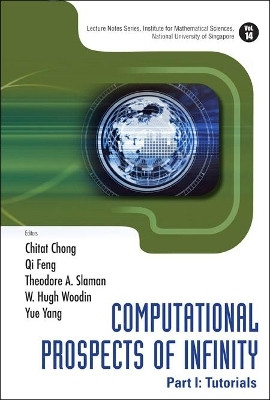
Computational Prospects Of Infinity - Part I: Tutorials - Tutorials(English, Hardcover, unknown)
- unknown
Paperback & Hardcover deals ―
Amazon IndiaGOFlipkart ₹ 8784SnapdealGOSapnaOnlineGOJain Book AgencyGOBooks WagonGOBook ChorGOCrosswordGODC BooksGOe-book & Audiobook deals ―
Amazon India GOGoogle Play Books GOAudible GO* Price may vary from time to time.
* GO = We're not able to fetch the price (please check manually visiting the website).
Know about the book -
Computational Prospects Of Infinity - Part I: Tutorials - Tutorials(English, Hardcover, unknown) is written by unknown and published by World Scientific Publishing Co Pte Ltd. It's available with International Standard Book Number or ISBN identification 9812796533 (ISBN 10) and 9789812796530 (ISBN 13).
This volume presents the written versions of the tutorial lectures given at the Workshop on Computational Prospects of Infinity, held from 18 June to 15 August 2005 at the Institute for Mathematical Sciences, National University of Singapore. It consists of articles by four of the leading experts in recursion theory (computability theory) and set theory. The survey paper of Rod Downey provides a comprehensive introduction to algorithmic randomness, one of the most active areas of current research in recursion theory. Theodore A Slaman's article is the first printed account of the ground-breaking work of Slaman-Woodin and Slaman-Shore on the definability of the Turing jump. John Steel presents some results on the properties of derived models of mice, and on the existence of mice with large derived models. The study was motivated by some of the well-known Holy Grails in inner model theory, including the Mouse Set Conjecture. In his presentation, W Hugh Woodin gives an outline of an expanded version (unpublished) on suitable extender sequences, a subject that was developed in the attempt to understand inner model theory for large cardinals beyond the level of superstrong cardinals.The volume serves as a useful guide for graduate students and researchers in recursion theory and set theory to some of the most important and significant developments in these subjects in recent years.
