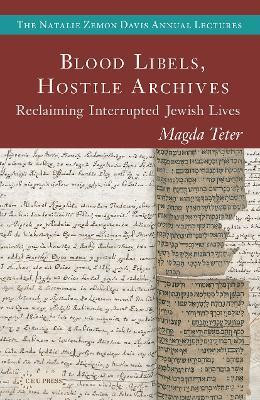
Blood Libels, Hostile Archives(English, Paperback, Teter Magda)
- Teter Magda
Paperback & Hardcover deals ―
Amazon IndiaGOFlipkart ₹ 5067SnapdealGOSapnaOnlineGOJain Book AgencyGOBooks Wagon₹511Book ChorGOCrosswordGODC BooksGOe-book & Audiobook deals ―
Amazon India GOGoogle Play Books GOAudible GO* Price may vary from time to time.
* GO = We're not able to fetch the price (please check manually visiting the website).
Know about the book -
Blood Libels, Hostile Archives(English, Paperback, Teter Magda) is written by Teter Magda and published by Central European University Press. It's available with International Standard Book Number or ISBN identification 9633868254 (ISBN 10) and 9789633868256 (ISBN 13).
As a minority group for most of their history, Jews were often marginalized and persecuted. Traces of their lives can be found in the archives of the dominant societies, but only as they intersected with the concerns of those in power. Just as Natalie Zemon Davis, Emmanuel Le Roy Ladurie, Carlo Ginzburg, and others recovered the voices of the peasants, so, too, scholars of Jewish history and culture have productively mined these reservoirs of evidence to retrieve glimpses of the ordinary lives of Jews. Blood Libels, Hostile Archives explores what can be reclaimed about everyday lives from what can be called "hostile archives"-from archival evidence produced and collected explicitly to manufacture malicious tales and pass them as "facts." For Jewish history, in some places, these archival sources may be the only remaining records documenting the lives of Jews there. The book explores two places: Trent, in northern Italy, and Sandomierz, in eastern Poland. Though hundreds of miles away, the towns have many things in common: both had been sites of anti-Jewish libels falsely accusing Jews of killing Christian children, Trent in 1475 and Sandomierz twice-in 1698 and 1710; in both, the instigators of the Jews' persecution left unique and extensive archives, both towns have physical remnants of these deadly affairs, and, finally, neither town has an existing Jewish population. Yet, centuries later, these anti-Jewish libels have not been relegated to the past; in both towns, their legacies still reverberate today.
