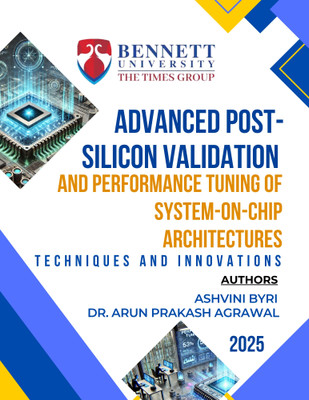
Advanced Post-Silicon Validation and Performance Tuning of System-on-Chip Architectures: Techniques and Innovations(Paperback, ASHVINI BYRI, DR. ARUN PRAKASH AGRAWAL)
- ASHVINI BYRI, DR. ARUN PRAKASH AGRAWAL
Paperback & Hardcover deals ―
Amazon IndiaGOFlipkart ₹ 795SnapdealGOSapnaOnlineGOJain Book AgencyGOBooks WagonGOBook ChorGOCrosswordGODC BooksGOe-book & Audiobook deals ―
Amazon India GOGoogle Play Books ₹7.99Audible GO* Price may vary from time to time.
* GO = We're not able to fetch the price (please check manually visiting the website).
Know about the book -
Advanced Post-Silicon Validation and Performance Tuning of System-on-Chip Architectures: Techniques and Innovations(Paperback, ASHVINI BYRI, DR. ARUN PRAKASH AGRAWAL) is written by ASHVINI BYRI, DR. ARUN PRAKASH AGRAWAL and published by DeepMisti Publication. It's available with International Standard Book Number or ISBN identification 9360444073 (ISBN 10) and 9789360444075 (ISBN 13).
The development and optimization of System-on-Chip (SoC) architectures play a critical role in the evolution of modern electronics, from mobile devices to embedded systems and beyond. As semiconductor technologies advance, the need for more sophisticated methods in post-silicon validation and performance tuning has become imperative. This book, Advanced Post-Silicon Validation and Performance Tuning of System-on-Chip Architectures: Techniques and Innovations, provides a deep dive into the latest methodologies and innovations that are shaping the future of SoC design and optimization.In this era of ever-shrinking transistors and increasingly complex integrated circuits, ensuring that a newly designed SoC performs reliably and efficiently in real-world conditions is a significant challenge. Traditional methods of validation and tuning, while effective, are no longer sufficient to keep pace with the rapid evolution of SoC architectures. The integration of multiple diverse components—such as processors, memory, peripherals, and accelerators—into a single chip brings forth a host of new challenges that demand advanced validation techniques to detect potential failures and performance bottlenecks.Authored by Ashvini Byri and Dr. Arun Prakash Agrawal, this work is a comprehensive guide to the state-of-the-art in post-silicon validation and performance optimization for SoC architectures. Drawing on years of research and practical experience, the authors explore cutting-edge techniques in hardware debugging, performance analysis, and tuning, offering insights into how these can be applied to enhance the robustness and efficiency of SoC designs. They delve into innovations in methodologies, including the use of machine learning algorithms for predictive analysis, advanced simulation models, and real-time validation processes that push the boundaries of traditional approaches.The authors bring together theoretical knowledge and practical solutions, making this book invaluable not only for researchers and academics but also for engineers and designers in the semiconductor industry. It serves as both a reference guide and a roadmap for those working in the high-tech industries where SoCs are the heart of innovation. By bridging the gap between design and implementation, this book enables professionals to ensure the highest levels of performance, reliability, and efficiency in their SoC architectures.Advanced Post-Silicon Validation and Performance Tuning of System-on-Chip Architectures is an essential resource for anyone seeking to understand the complexities of post-silicon validation and performance tuning in modern SoCs, offering a forward-looking perspective on how these technologies will continue to evolve in the coming years. Through the expertise of Ashvini Byri and Dr. Arun Prakash Agrawal, readers are equipped with the knowledge to tackle the challenges of next-generation semiconductor devices and systems..Authors
