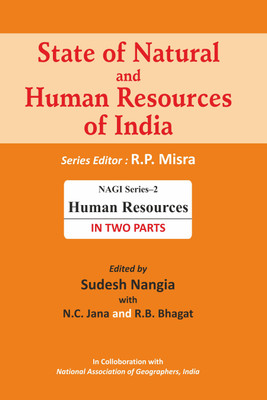
State of Natural and Human Resources of India First Edition(English, Hardcover, Nangia Sudesh)
- Nangia Sudesh
Paperback & Hardcover deals ―
Amazon IndiaGOFlipkart ₹ 1933SnapdealGOSapnaOnlineGOJain Book AgencyGOBooks Wagon₹3,815Book ChorGOCrosswordGODC BooksGOe-book & Audiobook deals ―
Amazon India GOGoogle Play Books GOAudible GO* Price may vary from time to time.
* GO = We're not able to fetch the price (please check manually visiting the website).
Know about the book -
State of Natural and Human Resources of India First Edition(English, Hardcover, Nangia Sudesh) is written by Nangia Sudesh and published by Concept Publishing Co. It's available with International Standard Book Number or ISBN identification 8180696898 (ISBN 10) and 9788180696893 (ISBN 13).
The present volume is a part of the NAGI Compendiums on State of Natural and Human Resources of India. The basic objective of editing this volume is to collate the recent research articles on human resources and comprehend the diversity of issues, which have become more relevant in today’s world, especially after the International Conference on Population and Development (ICPD-94), held at Rio de Janeiro. Needless to say that the studies on human resources would be incomplete without realizing their inter-disciplinary dimensions and hence contributions by non-geographers as well. The volume thus includes the articles written by the scholars from the disciplines of Demography, Sociology, Statistics, Anthropology etc. to enrich the scope of human resource development studies. This volume contains 47 articles of last fifteen years or so reproduced from 14 journals published in India and abroad. The book has been divided into four Sections. The articles cover wide-ranging issues such as spatial perspectives of population change, environmental regeneration and population stabilization, demographic transition, female age at marriage, sex composition, morbidity and mortality, literacy, work pattern, migration, women’s health, demographic data for decentralized planning, population growth and food security, population and disasters, urban and regional planning, population policies and programmes, women empowerment, status of women and fertility, human adaptation to environment, social differentiation of tribals, tribes in transition, Indian Diaspora etc. Like issues, methodology is also wide-ranging. The latest techniques and tools of analysis have been amply used. Needless to say, the volume would be of great relevance to the readers and researchers of Geography as well as other social science disciplines.
