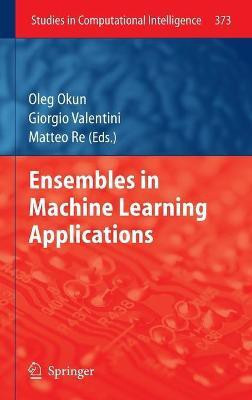
Ensembles in Machine Learning Applications(English, Hardcover, unknown)
- unknown
Paperback & Hardcover deals ―
Amazon IndiaGOFlipkart ₹ 11414SnapdealGOSapnaOnlineGOJain Book AgencyGOBooks Wagon₹697Book ChorGOCrosswordGODC BooksGOe-book & Audiobook deals ―
Amazon India GOGoogle Play Books GOAudible GO* Price may vary from time to time.
* GO = We're not able to fetch the price (please check manually visiting the website).
Know about the book -
Ensembles in Machine Learning Applications(English, Hardcover, unknown) is written by unknown and published by Springer-Verlag Berlin and Heidelberg GmbH & Co. KG. It's available with International Standard Book Number or ISBN identification 3642229093 (ISBN 10) and 9783642229091 (ISBN 13).
This book contains the extended papers presented at the 3rd Workshop on Supervised and Unsupervised Ensemble Methods and their Applications (SUEMA) that was held in conjunction with the European Conference on Machine Learning and Principles and Practice of Knowledge Discovery in Databases (ECML/PKDD 2010, Barcelona, Catalonia, Spain). As its two predecessors, its main theme was ensembles of supervised and unsupervised algorithms - advanced machine learning and data mining technique. Unlike a single classification or clustering algorithm, an ensemble is a group of algorithms, each of which first independently solves the task at hand by assigning a class or cluster label (voting) to instances in a dataset and after that all votes are combined together to produce the final class or cluster membership. As a result, ensembles often outperform best single algorithms in many real-world problems. This book consists of 14 chapters, each of which can be read independently of the others. In addition to two previous SUEMA editions, also published by Springer, many chapters in the current book include pseudo code and/or programming code of the algorithms described in them. This was done in order to facilitate ensemble adoption in practice and to help to both researchers and engineers developing ensemble applications.
