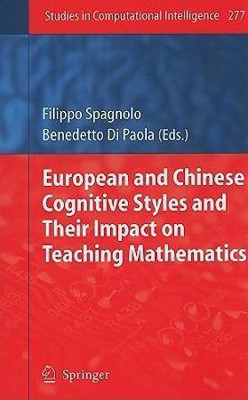
European and Chinese Cognitive Styles and their Impact on Teaching Mathematics(English, Hardcover, unknown)
- unknown
Paperback & Hardcover deals ―
Amazon IndiaGOFlipkart ₹ 5240SnapdealGOSapnaOnlineGOJain Book AgencyGOBooks Wagon₹364Book ChorGOCrosswordGODC BooksGOe-book & Audiobook deals ―
Amazon India GOGoogle Play Books GOAudible GO* Price may vary from time to time.
* GO = We're not able to fetch the price (please check manually visiting the website).
Know about the book -
European and Chinese Cognitive Styles and their Impact on Teaching Mathematics(English, Hardcover, unknown) is written by unknown and published by Springer-Verlag Berlin and Heidelberg GmbH & Co. KG. It's available with International Standard Book Number or ISBN identification 3642116795 (ISBN 10) and 9783642116797 (ISBN 13).
The book provides strong evidence that research on the cognitive processes from arithmetic thought to algebraic thought should take into consideration the socio-cultural context. It is an important contribution to the literature on linguistic structure in comparative studies related to Chinese student mathematics learning. This book not only makes a great contribution to research in mathematics education, the findings of this study also addressed insightful approaches and thoughts of understanding the development of algebraic thinking in cultural contexts for classroom teachers. Using written Chinese language from different theoretical references provided wonderful approaches for understanding student algebra cognitive development in a different way and calls educators for to pay special attention to an epistemological and linguistic view of algebraic development. The findings inform classroom teachers that the cultural context plays an important role in student learning mathematics. A typical analysis of the cognitive dimension involved in some in the historical and cultural contexts is a great resource for classroom teachers. I really enjoyed reading this book and learned a lot from its compelling analysis. Shuhua An, Associate Professor and Director of Graduate Program in Mathematics Education, California State University, Long Beach
