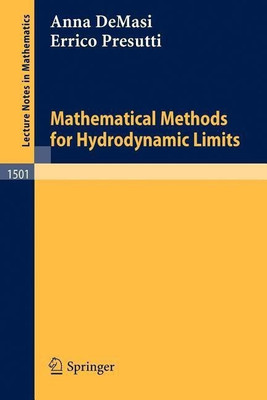
Mathematical Methods for Hydrodynamic Limits(English, Paperback, DeMasi Anna)
- DeMasi Anna
Paperback & Hardcover deals ―
Amazon IndiaGOFlipkart ₹ 3301SnapdealGOSapnaOnlineGOJain Book AgencyGOBooks Wagon₹527Book ChorGOCrosswordGODC BooksGOe-book & Audiobook deals ―
Amazon India GOGoogle Play Books GOAudible GO* Price may vary from time to time.
* GO = We're not able to fetch the price (please check manually visiting the website).
Know about the book -
Mathematical Methods for Hydrodynamic Limits(English, Paperback, DeMasi Anna) is written by DeMasi Anna and published by Springer-Verlag Berlin and Heidelberg GmbH & Co. KG. It's available with International Standard Book Number or ISBN identification 3540550046 (ISBN 10) and 9783540550044 (ISBN 13).
Entropy inequalities, correlation functions, couplingsbetween stochastic processes are powerful techniques whichhave been extensively used to give arigorous foundation tothe theory of complex, many component systems and to itsmany applications in a variety of fields as physics,biology, population dynamics, economics, ...The purpose of the book is to make theseand othermathematical methods accessible to readers with a limitedbackground in probability and physics by examining in detaila few models where the techniques emerge clearly, whileextra difficulties arekept to a minimum.Lanford's method and its extension to the hierarchy ofequations for the truncated correlation functions, thev-functions, are presented and applied to prove the validityof macroscopic equations forstochastic particle systemswhich are perturbations of the independent and of thesymmetric simple exclusion processes. Entropy inequalitiesare discussed in the frame of the Guo-Papanicolaou-Varadhantechnique and of theKipnis-Olla-Varadhan super exponentialestimates, with reference to zero-range models. Discretevelocity Boltzmann equations, reaction diffusionequations and non linear parabolic equations are considered,as limits of particles models. Phase separation phenomenaare discussed in the context of Glauber+Kawasaki evolutionsand reaction diffusion equations. Although the emphasis isonthe mathematical aspects, the physical motivations areexplained through theanalysis of the single models, withoutattempting, however to survey the entire subject ofhydrodynamical limits.
