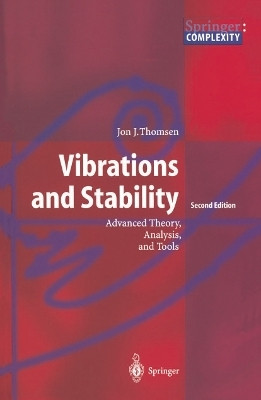
Vibrations and Stability(English, Hardcover, Thomsen Jon Juel)
- Thomsen Jon Juel
Paperback & Hardcover deals ―
Amazon IndiaGOFlipkart ₹ 8937SnapdealGOSapnaOnlineGOJain Book AgencyGOBooks Wagon₹303Book ChorGOCrosswordGODC BooksGOe-book & Audiobook deals ―
Amazon India GOGoogle Play Books GOAudible GO* Price may vary from time to time.
* GO = We're not able to fetch the price (please check manually visiting the website).
Know about the book -
Vibrations and Stability(English, Hardcover, Thomsen Jon Juel) is written by Thomsen Jon Juel and published by Springer-Verlag Berlin and Heidelberg GmbH & Co. KG. It's available with International Standard Book Number or ISBN identification 3540401407 (ISBN 10) and 9783540401407 (ISBN 13).
'Vibrations and Stability' is aimed at third to fifth-year undergraduates and post- graduates in mechanical or structural engineering. The book covers a range of subjects relevant for a one-or two-semester course in advanced vibrations and stability. Also, it can be used for self-study, e. g. , by students on master or PhD projects, researchers, and professional engineers. The focus is on nonlinear phe- nomena and tools, covering the themes of local perturbation analysis (Chaps. 3 and 4), bifurcation analysis (Chap. 5), global analysis I chaos theory (Chap. 6), and special high-frequency effects (Chap. 7). The ground for nonlinear analysis is laid with a brief summary of elementary linear vibration theory (Chap. 1), and a treatment of differential eigenvalue problems in some depth (Chap. 2). Also, there are exercise problems and extensive bibliographic references to serve the needs of both students and more experienced users; major exercises for course-work; and appendices on numerical simulation, standard mathematical formulas, vibration properties of basic structural elements, and properties of engineering materials. This Second Edition is a revised and expanded version of the first edition (pub- lished by McGraw-Hill in 1997), reflecting the experience gathered during its now six years in service as a classroom or self-study text for students and researchers. The second edition contains a major new chapter (7), three new appendices, many new exercise problems, more than 120 new and updated bibliographic references, and hundreds of minor updates, corrections, and clarifications.
