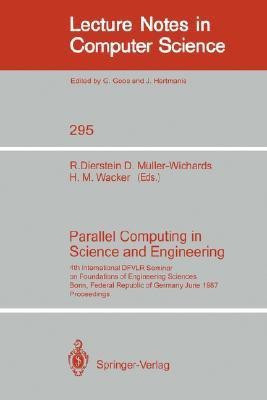
Parallel Computing in Science and Engineering(English, Paperback, unknown)
- unknown
Paperback & Hardcover deals ―
Amazon IndiaGOFlipkart ₹ 3222SnapdealGOSapnaOnlineGOJain Book AgencyGOBooks Wagon₹489Book ChorGOCrosswordGODC BooksGOe-book & Audiobook deals ―
Amazon India GOGoogle Play Books GOAudible GO* Price may vary from time to time.
* GO = We're not able to fetch the price (please check manually visiting the website).
Know about the book -
Parallel Computing in Science and Engineering(English, Paperback, unknown) is written by unknown and published by Springer-Verlag Berlin and Heidelberg GmbH & Co. KG. It's available with International Standard Book Number or ISBN identification 3540189238 (ISBN 10) and 9783540189237 (ISBN 13).
It was the aim of the conference to present issues in parallel computing to a community of potential engineering/scientific users. An overview of the state-of-the-art in several important research areas is given by leading scientists in their field. The classification question is taken up at various points, ranging from parametric characterizations, communication structure, and memory distribution to control and execution schemes. Central issues in multiprocessing hardware and operation, such as scalability, techniques of overcoming memory latency and synchronization overhead, as well as fault tolerance of communication networks are discussed. The problem of designing and debugging parallel programs in a user-friendly environment is addressed and a number of program transformations for enhancing vectorization and parallelization in a variety of program situations are described. Two different algorithmic techniques for the solution of certain classes of partial differential equations are discussed. The properties of domain-decomposition algorithms and their mapping onto a CRAY-XMP-type architecture are investigated and an overview is given of the merit of various approaches to exploiting the acceleration potential of multigrid methods. Finally, an abstract performance modeling technique for the behavior of applications on parallel and vector architectures is described.
