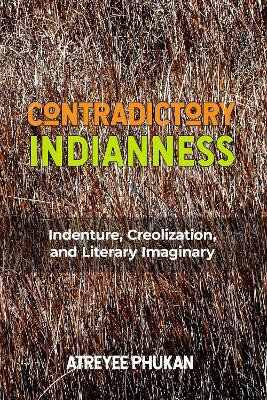
Contradictory Indianness(English, Paperback, Phukan Atreyee)
- Phukan Atreyee
Paperback & Hardcover deals ―
Amazon IndiaGOFlipkart ₹ 3636SnapdealGOSapnaOnlineGOJain Book AgencyGOBooks Wagon₹10,011Book ChorGOCrosswordGODC BooksGOe-book & Audiobook deals ―
Amazon India GOGoogle Play Books GOAudible GO* Price may vary from time to time.
* GO = We're not able to fetch the price (please check manually visiting the website).
Know about the book -
Contradictory Indianness(English, Paperback, Phukan Atreyee) is written by Phukan Atreyee and published by Rutgers University Press. It's available with International Standard Book Number or ISBN identification 1978829108 (ISBN 10) and 9781978829107 (ISBN 13).
As Contradictory Indianness shows, a postcolonial Caribbean aesthetics that has from its inception privileged inclusivity, interraciality, and resistance against Old World colonial orders requires taking into account Indo-Caribbean writers and their reimagining of Indianness in the region. Whereas, for instance, forms of Indo-Caribbean cultural expression in music, cuisine, or religion are more readily accepted as creolizing (thus, Caribbeanizing) processes, an Indo-Caribbean literary imaginary has rarely been studied as such. Discussing the work of Ismith Khan, Harold Sonny Ladoo, Totaram Sanadhya, LalBihari Sharma, and Shani Mootoo, Contradictory Indianness maintains that the writers' engagement with the regional and transnational poetics of the Caribbean underscores symbolic bridges between cultural worlds conventionally set apart-the Africanized and Indianized-and distinguishes between cultural worlds assumed to be the same-indenture and South Asian Indianness. This book privileges Indo-Caribbean fiction as a creolizing literary imaginary to broaden its study beyond a narrow canon that has, inadvertently or not, enabled monolithic and unidimensional perceptions of Indian cultural identity and evolution in the Caribbean, and continued to impose a fragmentary and disconnected study of (post)indenture aesthetics within indenture's own transnational cartography.
