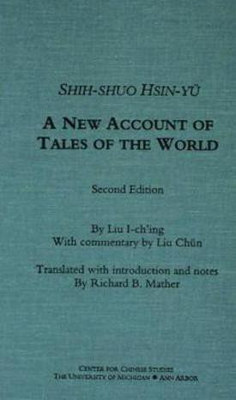
Shih-shuo Hsin-yue(English, Paperback, Mather Richard)
- Mather Richard
Paperback & Hardcover deals ―
Amazon IndiaGOFlipkart ₹ 6183SnapdealGOSapnaOnlineGOJain Book AgencyGOBooks Wagon₹340Book ChorGOCrosswordGODC BooksGOe-book & Audiobook deals ―
Amazon India GOGoogle Play Books GOAudible GO* Price may vary from time to time.
* GO = We're not able to fetch the price (please check manually visiting the website).
Know about the book -
Shih-shuo Hsin-yue(English, Paperback, Mather Richard) is written by Mather Richard and published by The University of Michigan Press. It's available with International Standard Book Number or ISBN identification 1938937015 (ISBN 10) and 9781938937019 (ISBN 13).
Shih-shuo hsin-yue: A New Account of Tales of the World, compiled by Liu I-ch'ing (403-444), is a collection of anecdotes, short conversations, and pithy observations on personalities who lived in China between about 150 and 420 A.D. In its own time, the text was considered to be an aid to conversation, and one of its aims was to provide enjoyable reading. For this reason, it has been loosely linked with the later "novels" (hsiao-shuo) such as "Romance of the Three Kingdoms" (San-kuo yen-i). Shih-shuo hsin- yue is organized thematically, with sections devoted to civic and moral virtues, cultivated and intellectual accomplishments, recluses, women, technology, art, and human frailty. Yet the view onto these subjects remains narrow: center stage is occupied by emperors and princes, courtiers, officials, generals, genteel hermits, and urbane monks. These figures are depicted in a rarified atmosphere of great refinement and sensitivity, yet they are usually caught up in a very earthly, often bloody, world of war and factional intrigue. It is a dark world against which the occasional flashes of wit and insight shine the more brightly. Mather's classic translation was the first English translation of the work when it appeared in 1971. Mather incorporates the commentary of Liu Chun (461-521), which provides invaluable contextualizing information from works of the third and fourth centuries that are now lost. The second edition has been comprehensively revised, introducing numerous collaborative corrections and improvements.
