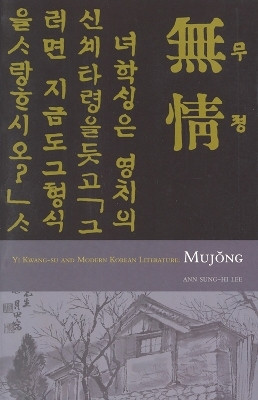
Mujong (the Heartless)(English, Paperback, Yi Kwang-su)
- Yi Kwang-su
Paperback & Hardcover deals ―
Amazon IndiaGOFlipkart ₹ 4076SnapdealGOSapnaOnlineGOJain Book AgencyGOBooks Wagon₹10,248Book ChorGOCrosswordGODC BooksGOe-book & Audiobook deals ―
Amazon India GOGoogle Play Books GOAudible GO* Price may vary from time to time.
* GO = We're not able to fetch the price (please check manually visiting the website).
Know about the book -
Mujong (the Heartless)(English, Paperback, Yi Kwang-su) is written by Yi Kwang-su and published by Cornell University Press. It's available with International Standard Book Number or ISBN identification 188544527X (ISBN 10) and 9781885445278 (ISBN 13).
Yi Kwang-su (1892-1950) was one of the pioneers of modern Korean literature. When the serialization of Mujong (The Heartless) began in 1917, it was an immediate sensation, and it occupies a prominent place in the Korean literary canon. The Heartless is the story of a love triangle among three youths during the Japanese occupation. Yi HyAng-sik is a young man in his mid-twenties who is teaching English at a middle school in Seoul. Brilliant but also shy and indecisive, he is torn between two women. Kim SAn-hyAng is from a wealthy Christian family; she has just graduated from a modern, Western-style school and is planning on continuing her studies in the United States. Pak YAng-ch'ae is a musically gifted young woman who was raised in a traditional Confucian manner; due to family misfortune, she has become a kisaeng but remains devoted to HyAng-sik whom she knew as a child. The Heartless goes beyond the level of romantic melodrama and uses these characters to depict Korea's struggles with modern culture and national identity. A long critical introduction discusses Yi Kwang-su's life and work from his birth in 1892 to the publication of his first novel The Heartless in 1917. It contains in-depth analyses of the novel, Yi Kwang-su's literary theory, and early short stories.
