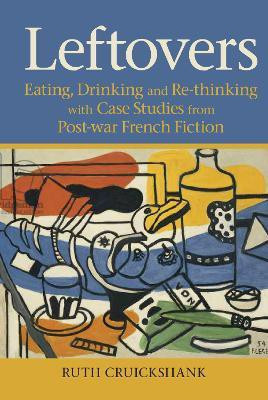
Leftovers(English, Paperback, Cruickshank Ruth)
- Cruickshank Ruth
Paperback & Hardcover deals ―
Amazon IndiaGOFlipkart ₹ 4017SnapdealGOSapnaOnlineGOJain Book AgencyGOBooks Wagon₹909Book ChorGOCrosswordGODC BooksGOe-book & Audiobook deals ―
Amazon India GOGoogle Play Books GOAudible GO* Price may vary from time to time.
* GO = We're not able to fetch the price (please check manually visiting the website).
Know about the book -
Leftovers(English, Paperback, Cruickshank Ruth) is written by Cruickshank Ruth and published by Liverpool University Press. It's available with International Standard Book Number or ISBN identification 1802077529 (ISBN 10) and 9781802077520 (ISBN 13).
Eating and drinking are essential to survival. Yet for human animals, they are intrinsically ambivalent, proliferating with ideological, historical and psychological leftovers. This study reveals and mobilizes the provisional meanings, repressed experiences and unacknowledged tensions bound up with representations of food, drink and their consumption. It creates a flexible critical framework by bringing together an unexploited convergence of post-war French thinkers who use - or whose thought is legible through - figures of eating and drinking, including Barthes, Bataille, Beauvoir, Bourdieu, Certeau, Cixous, Derrida, Fischler, Giard, Kristeva, Lacan, Lefebvre, Levi-Strauss, Mayol and Sartre. New combinations emerge for elucidating the intersecting effects of incorporation; constructs of class, gender and racial difference; bad faith; distinction; secondary ideological signifying systems; provisional meanings bound up with linguistic traces; economies of excess; everyday 'making-do'; the ethics of consuming the other; the return of the repressed; lack; abjection; and notions of 'eating on the sly', 'mother's milk', the 'omnivore's paradox' and 'gastro-anomie'. The vast possibilities for re-thinking with eating and drinking are further exemplified in case studies of novels in which - often beyond authorial intentions - food and drink are structurally important and interpretatively plural. These are Robbe-Grillet's Les Gommes/The Erasers (1953); Ernaux's Les Armoires vides/Cleaned Out (1974); Darrieussecq's Truismes/Pig Tales (1996); and Houellebecq's La Carte et le territoire/The Map and the Territory (2010). New understandings of post-war French cultural production are revealed in these case studies. But above all, the analyses demonstrate the potential for literary, comparative, cultural, film, gender and food studies of re-thinking with eating and drinking across genres, periods and places.
