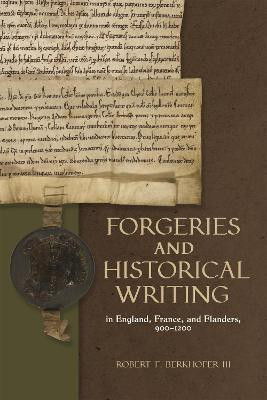
Forgeries and Historical Writing in England, France, and Flanders, 900-1200(English, Hardcover, Berkhofer III Robert F.)
- Berkhofer III Robert F.
Paperback & Hardcover deals ―
Amazon IndiaGOFlipkart ₹ 3265SnapdealGOSapnaOnlineGOJain Book AgencyGOBooks WagonGOBook ChorGOCrosswordGODC BooksGOe-book & Audiobook deals ―
Amazon India GOGoogle Play Books GOAudible GO* Price may vary from time to time.
* GO = We're not able to fetch the price (please check manually visiting the website).
Know about the book -
Forgeries and Historical Writing in England, France, and Flanders, 900-1200(English, Hardcover, Berkhofer III Robert F.) is written by Berkhofer III Robert F. and published by Boydell & Brewer Ltd. It's available with International Standard Book Number or ISBN identification 1783276916 (ISBN 10) and 9781783276912 (ISBN 13).
A close analysis of forgeries and historical writings at Saint Peter's, Ghent; Saint-Denis near Paris; and Christ Church, Canterbury, offering valuable access to why medieval people often rewrote their pasts.What modern scholars call "forgeries" (be they texts, seals, coins, or relics) flourished in the central Middle Ages. Although lying was considered wrong throughout the period, such condemnation apparently did not extend to forgeries. Rewriting documents was especially common among monks, who exploited their mastery of writing to reshape their records. Monastic scribes frequently rewrote their archives, using charters, letters, and narratives, to create new usable pasts for claiming lands and privileges in their present or future. Such imagined histories could also be deployed to "reform" their community or reshape its relationship with lay and ecclesiastical authorities. Although these creative rewritings were forgeries, they still can be valuable evidence of medieval mentalities. While forgeries cannot easily be used to reconstruct what did happen, forgeries embedded in historical narratives show what their composers believed should have happened and thus they offer valuable access to why medieval people rewrote their pasts.This book offers close analysis of three monastic archives over the long eleventh century: Saint Peter's, Ghent; Saint-Denis near Paris; and Christ Church, Canterbury. These foci provide the basis for contextualizing key shifts in documentary culture in the twelfth century across Europe. Overall, the book argues that connections between monastic forgeries and historical writing in the tenth through twelfth centuries reveal attempts to reshape reality. Both sought to rewrite the past and thereby promote monks' interests in their present or future.
