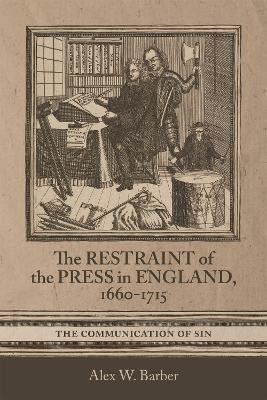
The Restraint of the Press in England, 1660-1715(English, Hardcover, Barber Alex W.)
- Barber Alex W.
Paperback & Hardcover deals ―
Amazon IndiaGOFlipkart ₹ 11067SnapdealGOSapnaOnlineGOJain Book AgencyGOBooks Wagon₹946Book ChorGOCrosswordGODC BooksGOe-book & Audiobook deals ―
Amazon India GOGoogle Play Books GOAudible GO* Price may vary from time to time.
* GO = We're not able to fetch the price (please check manually visiting the website).
Know about the book -
The Restraint of the Press in England, 1660-1715(English, Hardcover, Barber Alex W.) is written by Barber Alex W. and published by Boydell & Brewer Ltd. It's available with International Standard Book Number or ISBN identification 1783275170 (ISBN 10) and 9781783275175 (ISBN 13).
A discussion of the fascinating interplay between communication, politics and religion in early modern England suggesting a new framework for the politics of print culture.This book challenges the idea that the loss of pre-publication licensing in 1695 unleashed a free press on an unsuspecting political class, setting England on the path to modernity. England did not move from a position of complete control of the press to one of complete freedom. Instead, it moved from pre-publication censorship to post-publication restraint. Political and religious authorities and their agents continued to shape and manipulate information. Authors, printers, publishers and book agents were continually harassed. The book trade reacted by practicing self-censorship. At times of political calm, government and the book trade colluded in a policy of policing rather than punishment.The Restraint of the Press in England problematizes the notion of the birth of modernity, a moment claimed by many prominent scholars to have taken place at the transition from the seventeenth into the eighteenth century. What emerges from this study is not a steady move to liberalism, democracy or modernity. Rather, after 1695, England was a religious and politically fractured society, in which ideas of the sovereignty of the people and the power of public opinion were being established and argued about.
