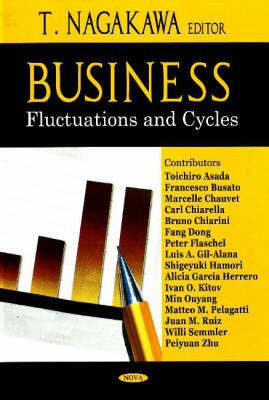
Business Fluctuations & Cycles(English, Hardcover, unknown)
- unknown
Paperback & Hardcover deals ―
Amazon IndiaGOFlipkart ₹ 2826SnapdealGOSapnaOnlineGOJain Book AgencyGOBooks Wagon₹3,872Book ChorGOCrosswordGODC BooksGOe-book & Audiobook deals ―
Amazon India GOGoogle Play Books GOAudible GO* Price may vary from time to time.
* GO = We're not able to fetch the price (please check manually visiting the website).
Know about the book -
Business Fluctuations & Cycles(English, Hardcover, unknown) is written by unknown and published by Nova Science Publishers Inc. It's available with International Standard Book Number or ISBN identification 1600215033 (ISBN 10) and 9781600215032 (ISBN 13).
The business cycle or economic cycle refers to the periodic fluctuations of economic activity about its long term growth trend. The cycle involves shifts over time between periods of relatively rapid growth of output (recovery and prosperity), alternating with periods of relative stagnation or decline (contraction or recession). These fluctuations are often measured using the real gross domestic product. One of the government's main roles is to smooth out the business cycle and reduce its fluctuations. To call those alternances 'cycles' is rather misleading as they don't tend to repeat at fairly regular time intervals. Most observers find that their lengths (from peak to peak, or from trough to trough) vary, so that cycles are not mechanical in their regularity. Since no two cycles are alike in their details, some economists dispute the existence of cycles and use the word 'fluctuations' (or the like) instead. Others see enough similarities between cycles that the cycle is a valid basis of studying the state of the economy. A key question is whether or not there are similar mechanisms that generate recessions and/or booms that exist in capitalist economies so that the dynamics that appear as a cycle will be seen again and again. This new book presents leading-edge research in this field.
