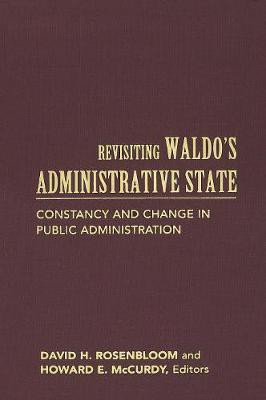
Revisiting Waldo's Administrative State(English, Hardcover, unknown)
- unknown
Paperback & Hardcover deals ―
Amazon IndiaGOFlipkart ₹ 2673SnapdealGOSapnaOnlineGOJain Book AgencyGOBooks Wagon₹417Book ChorGOCrosswordGODC BooksGOe-book & Audiobook deals ―
Amazon India GOGoogle Play Books GOAudible GO* Price may vary from time to time.
* GO = We're not able to fetch the price (please check manually visiting the website).
Know about the book -
Revisiting Waldo's Administrative State(English, Hardcover, unknown) is written by unknown and published by Georgetown University Press. It's available with International Standard Book Number or ISBN identification 1589010922 (ISBN 10) and 9781589010925 (ISBN 13).
The prevailing notion that the best government is achieved through principles of management and business practices is hardly new - it echoes the early twentieth-century "gospel of efficiency" challenged by Dwight Waldo in 1948 in his path-breaking book, "The Administrative State". Asking, "Efficiency for what?", Waldo warned that public administrative efficiency must be backed by a framework of consciously held democratic values. "Revisiting Waldo's Administrative State" brings together a group of distinguished authors who critically explore public administration's big ideas and issues and question whether contemporary efforts to "reinvent government", promote privatization, and develop new public management approaches constitute a coherent political theory capable of meeting the complex challenges of governing in a democracy. Taking Waldo's book as a starting point, the authors revisit and update his key concepts and consider their applicability for today.The book follows Waldo's conceptual structure, first probing the material and ideological background of modern public administration, problems of political philosophy, and finally particular challenges inherent in contemporary administrative reform. It concludes with a look ahead to "wicked" policy problems - such as terrorism, global warming, and ecological threats - whose scope is so global and complex that they will defy any existing administrative structures and values. Calling for a return to conscious consideration of democratic accountability, fairness, justice, and transparency in government, the book's conclusion assesses the future direction of public administrative thought. This book can stand alone as a commentary on reconciling democratic values and governance today or as a companion when reading Waldo's classic volume.
