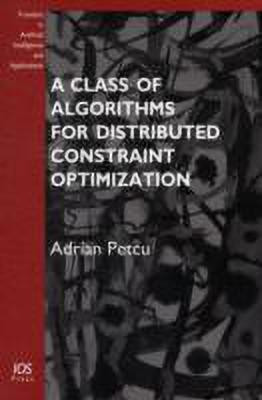
A Class of Algorithms for Distributed Constraint Optimization(English, Paperback, unknown)
- unknown
Paperback & Hardcover deals ―
Amazon IndiaGOFlipkart ₹ 2691SnapdealGOSapnaOnlineGOJain Book AgencyGOBooks Wagon₹413Book ChorGOCrosswordGODC BooksGOe-book & Audiobook deals ―
Amazon India GOGoogle Play Books GOAudible GO* Price may vary from time to time.
* GO = We're not able to fetch the price (please check manually visiting the website).
Know about the book -
A Class of Algorithms for Distributed Constraint Optimization(English, Paperback, unknown) is written by unknown and published by IOS Press. It's available with International Standard Book Number or ISBN identification 158603989X (ISBN 10) and 9781586039899 (ISBN 13).
Multi Agent Systems (MAS) have recently attracted a lot of interest because of their ability to model many real life scenarios where information and control are distributed among a set of different agents. Practical applications include planning, scheduling, distributed control, resource allocation etc. A major challenge in such systems is coordinating agent decisions, such that a globally optimal outcome is achieved. Distributed Constraint Optimization Problems (DCOP) are a framework that recently emerged as one of the most successful approaches to coordination in MAS. "A Class of Algorithms for Distributed Constraint Optimization" addresses three major issues that arise in DCOP: efficient optimization algorithms, dynamic and open environments, and manipulations from self-interested users. It makes significant contributions in all these directions by introducing a series of DCOP algorithms, which are based on dynamic programming and largely outperform previous DCOP algorithms. The basis of this class of algorithms is DPOP, a distributed algorithm that requires only a linear number of messages, thus incurring low networking overhead.For dynamic environments, self-stabilizing algorithms that can deal with changes and continuously update their solutions are introduced. For self interested users, the author proposes the M-DPOP algorithm, which is the first DCOP algorithm that makes honest behavior an ex-post Nash equilibrium by implementing the VCG mechanism distributedly. The book also discusses the issue of budget balance and mentions two algorithms that allow for redistributing (some of) the VCG payments back to the agents, thus avoiding the welfare loss caused by wasting the VCG taxes.
