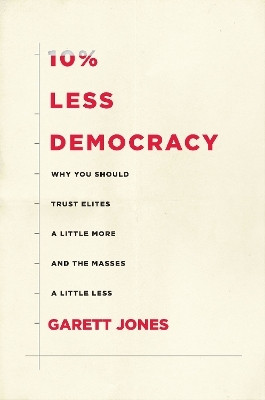
10% Less Democracy(English, Paperback, Jones Garett)
- Jones Garett
Paperback & Hardcover deals ―
Amazon IndiaGOFlipkart ₹ 2156SnapdealGOSapnaOnlineGOJain Book AgencyGOBooks WagonGOBook ChorGOCrosswordGODC BooksGOe-book & Audiobook deals ―
Amazon India GOGoogle Play Books GOAudible GO* Price may vary from time to time.
* GO = We're not able to fetch the price (please check manually visiting the website).
Know about the book -
10% Less Democracy(English, Paperback, Jones Garett) is written by Jones Garett and published by Stanford University Press. It's available with International Standard Book Number or ISBN identification 1503628973 (ISBN 10) and 9781503628977 (ISBN 13).
During the 2016 presidential election, both Donald Trump and Bernie Sanders argued that elites were hurting the economy. But, drawing together evidence and theory from across economics, political science, and even finance, Garett Jones says otherwise. In 10% Less Democracy, he makes the case that the richest, most democratic nations would be better off if they slightly reduced accountability to the voting public, turning up the dial on elite influence. To do this, Jones builds on three foundational lines of evidence in areas where he has personal experience. First, as a former staffer in the U.S. Senate, he saw how senators voted differently as elections grew closer. Second, as a macroeconomist, Jones knows the merits of "independent" central banks, which sit apart from the political process and are controlled by powerful insiders. The consensus of the field is that this detached, technocratic approach has worked far better than more political and democratic banking systems. Third, his previous research on the effects of cognitive skills on political, social, and economic systems revealed many ways in which well-informed voters improve government. Discerning repeated patterns, Jones draws out practical suggestions for fine-tuning, focusing on the length of political terms, the independence of government agencies, the weight that voting systems give to the more-educated, and the value of listening more closely to a group of farsighted stakeholders with real skin in the game-a nation's sovereign bondholders. Accessible to political news junkies while firmly rooted and rigorous, 10% Less Democracy will fuel the national conversation about what optimal government looks like.
