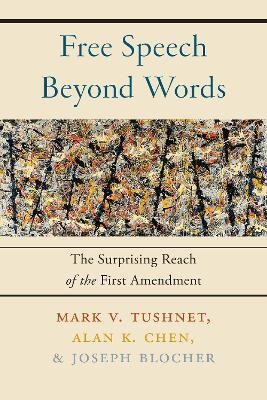
Free Speech Beyond Words(English, Paperback, Tushnet Mark V.)
- Tushnet Mark V.
Paperback & Hardcover deals ―
Amazon IndiaGOFlipkart ₹ 2428SnapdealGOSapnaOnlineGOJain Book AgencyGOBooks Wagon₹214Book ChorGOCrosswordGODC BooksGOe-book & Audiobook deals ―
Amazon India GOGoogle Play Books GOAudible GO* Price may vary from time to time.
* GO = We're not able to fetch the price (please check manually visiting the website).
Know about the book -
Free Speech Beyond Words(English, Paperback, Tushnet Mark V.) is written by Tushnet Mark V. and published by New York University Press. It's available with International Standard Book Number or ISBN identification 1479805513 (ISBN 10) and 9781479805518 (ISBN 13).
A look at First Amendment coverage of music, non-representational art, and nonsense The Supreme Court has unanimously held that Jackson Pollock's paintings, Arnold Schoeenberg's music, and Lewis Carroll's poem "Jabberwocky" are "unquestionably shielded" by the First Amendment. Nonrepresentational art, instrumental music, and nonsense: all receive constitutional coverage under an amendment protecting "the freedom of speech," even though none involves what we typically think of as speech-the use of words to convey meaning. As a legal matter, the Court's conclusion is clearly correct, but its premises are murky, and they raise difficult questions about the possibilities and limitations of law and expression. Nonrepresentational art, instrumental music, and nonsense do not employ language in any traditional sense, and sometimes do not even involve the transmission of articulable ideas. How, then, can they be treated as "speech" for constitutional purposes? What does the difficulty of that question suggest for First Amendment law and theory? And can law resolve such inquiries without relying on aesthetics, ethics, and philosophy? Comprehensive and compelling, this book represents a sustained effort to account, constitutionally, for these modes of "speech." While it is firmly centered in debates about First Amendment issues, it addresses them in a novel way, using subject matter that is uniquely well suited to the task, and whose constitutional salience has been under-explored. Drawing on existing legal doctrine, aesthetics, and analytical philosophy, three celebrated law scholars show us how and why speech beyond words should be fundamental to our understanding of the First Amendment.
