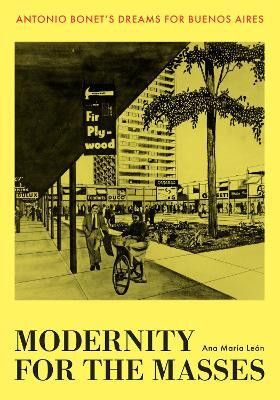
Modernity for the Masses(English, Hardcover, Leon Ana Maria)
- Leon Ana Maria
Paperback & Hardcover deals ―
Amazon IndiaGOFlipkart ₹ 3799SnapdealGOSapnaOnlineGOJain Book AgencyGOBooks Wagon₹4,404Book ChorGOCrosswordGODC BooksGOe-book & Audiobook deals ―
Amazon India GOGoogle Play Books GOAudible GO* Price may vary from time to time.
* GO = We're not able to fetch the price (please check manually visiting the website).
Know about the book -
Modernity for the Masses(English, Hardcover, Leon Ana Maria) is written by Leon Ana Maria and published by University of Texas Press. It's available with International Standard Book Number or ISBN identification 1477321780 (ISBN 10) and 9781477321782 (ISBN 13).
2022 PROSE Award Finalist in Architecture and Urban Planning 2022 Association for Latin American Art Arvey Foundation Book Award, Honorable Mention Throughout the early twentieth century, waves of migration brought working-class people to the outskirts of Buenos Aires. This prompted a dilemma: Where should these restive populations be situated relative to the city's spatial politics? Might housing serve as a tool to discipline their behavior? Enter Antonio Bonet, a Catalan architect inspired by the transatlantic modernist and surrealist movements. Ana MarIa LeOn follows Bonet's decades-long, state-backed quest to house Buenos Aires's diverse and fractious population. Working with totalitarian and populist regimes, Bonet developed three large-scale housing plans, each scuttled as a new government took over. Yet these incomplete plans-Bonet's dreams-teach us much about the relationship between modernism and state power. Modernity for the Masses finds in Bonet's projects the disconnect between modern architecture's discourse of emancipation and the reality of its rationalizing control. Although he and his patrons constantly glorified the people and depicted them in housing plans, Bonet never consulted them. Instead he succumbed to official and elite fears of the people's latent political power. In careful readings of Bonet's work, LeOn discovers the progressive erasure of surrealism's psychological sensitivity, replaced with an impulse, realized in modernist design, to contain the increasingly empowered population.
