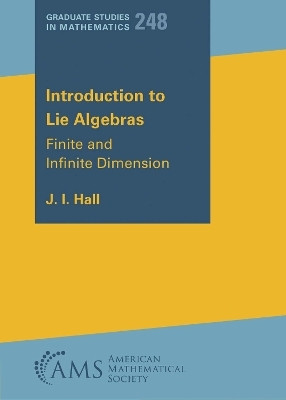
Introduction to Lie Algebras(English, Paperback, Hall J. I.)
- Hall J. I.
Paperback & Hardcover deals ―
Amazon IndiaGOFlipkart ₹ 9748SnapdealGOSapnaOnlineGOJain Book AgencyGOBooks Wagon₹144Book ChorGOCrosswordGODC BooksGOe-book & Audiobook deals ―
Amazon India GOGoogle Play Books GOAudible GO* Price may vary from time to time.
* GO = We're not able to fetch the price (please check manually visiting the website).
Know about the book -
Introduction to Lie Algebras(English, Paperback, Hall J. I.) is written by Hall J. I. and published by American Mathematical Society. It's available with International Standard Book Number or ISBN identification 147047915X (ISBN 10) and 9781470479152 (ISBN 13).
Being both a beautiful theory and a valuable tool, Lie algebras form a very important area of mathematics. This modern introduction targets entry-level graduate students. It might also be of interest to those wanting to refresh their knowledge of the area and be introduced to newer material. Infinite-dimensional algebras are treated extensively along with the finite-dimensional ones. After some motivation, the text gives a detailed and concise treatment of the Killing-Cartan classification of finite-dimensional semisimple algebras over algebraically closed fields of characteristic 0. Important constructions such as Chevalley bases follow. The second half of the book serves as a broad introduction to algebras of arbitrary dimension, including Kac-Moody (KM), loop, and affine KM algebras. Finite-dimensional semisimple algebras are viewed as KM algebras of finite dimension, their representation and character theory developed in terms of integrable representations. The text also covers triangular decomposition (after Moody and Pianzola) and the BGG category $\mathcal{O}$. A lengthy chapter discusses the Virasoro algebra and its representations. Several applications to physics are touched on via differential equations, Lie groups, superalgebras, and vertex operator algebras. Each chapter concludes with a problem section and a section on context and history. There is an extensive bibliography, and appendices present some algebraic results used in the book.
