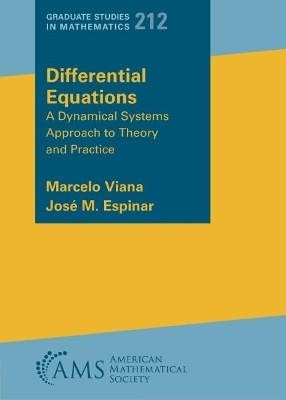
Differential Equations(English, Paperback, Viana Marcelo)
- Viana Marcelo
Paperback & Hardcover deals ―
Amazon IndiaGOFlipkart ₹ 9941SnapdealGOSapnaOnlineGOJain Book AgencyGOBooks Wagon₹10,353Book ChorGOCrosswordGODC BooksGOe-book & Audiobook deals ―
Amazon India GOGoogle Play Books ₹85Audible GO* Price may vary from time to time.
* GO = We're not able to fetch the price (please check manually visiting the website).
Know about the book -
Differential Equations(English, Paperback, Viana Marcelo) is written by Viana Marcelo and published by American Mathematical Society. It's available with International Standard Book Number or ISBN identification 147046540X (ISBN 10) and 9781470465407 (ISBN 13).
This graduate-level introduction to ordinary differential equations combines both qualitative and numerical analysis of solutions, in line with Poincare's vision for the field over a century ago. Taking into account the remarkable development of dynamical systems since then, the authors present the core topics that every young mathematician of our time--pure and applied alike--ought to learn. The book features a dynamical perspective that drives the motivating questions, the style of exposition, and the arguments and proof techniques. The text is organized in six cycles. The first cycle deals with the foundational questions of existence and uniqueness of solutions. The second introduces the basic tools, both theoretical and practical, for treating concrete problems. The third cycle presents autonomous and non-autonomous linear theory. Lyapunov stability theory forms the fourth cycle. The fifth one deals with the local theory, including the Grobman-Hartman theorem and the stable manifold theorem. The last cycle discusses global issues in the broader setting of differential equations on manifolds, culminating in the Poincare-Hopf index theorem. The book is appropriate for use in a course or for self-study. The reader is assumed to have a basic knowledge of general topology, linear algebra, and analysis at the undergraduate level. Each chapter ends with a computational experiment, a diverse list of exercises, and detailed historical, biographical, and bibliographic notes seeking to help the reader form a clearer view of how the ideas in this field unfolded over time.
