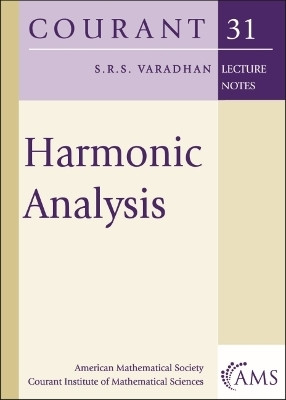
Harmonic Analysis(English, Paperback, Courant Institute of Mathematical Sciences at New York University S.R.S.)
- Courant Institute of Mathematical Sciences at New York University S.R.S.
Paperback & Hardcover deals ―
Amazon IndiaGOFlipkart ₹ 2583SnapdealGOSapnaOnlineGOJain Book AgencyGOBooks Wagon₹259Book ChorGOCrosswordGODC BooksGOe-book & Audiobook deals ―
Amazon India GOGoogle Play Books GOAudible GO* Price may vary from time to time.
* GO = We're not able to fetch the price (please check manually visiting the website).
Know about the book -
Harmonic Analysis(English, Paperback, Courant Institute of Mathematical Sciences at New York University S.R.S.) is written by Courant Institute of Mathematical Sciences at New York University S.R.S. and published by American Mathematical Society. It's available with International Standard Book Number or ISBN identification 1470465078 (ISBN 10) and 9781470465070 (ISBN 13).
Harmonic Analysis is an important tool that plays a vital role in many areas of mathematics as well as applications. It studies functions by decomposing them into components that are special functions. A prime example is decomposing a periodic function into a linear combination of sines and cosines. The subject is vast, and this book covers only the selection of topics that was dealt with in the course given at the Courant Institute in 2000 and 2019. These include standard topics like Fourier series and Fourier transforms of functions, as well as issues of convergence of Abel, Feier, and Poisson sums. At a slightly more advanced level the book studies convolutions with singular integrals, fractional derivatives, Sobolev spaces, embedding theorems, Hardy spaces, and BMO. Applications to elliptic partial differential equations and prediction theory are explored. Some space is devoted to harmonic analysis on compact non-Abelian groups and their representations, including some details about two groups: the permutation group and SO(3). The text contains exercises at the end of most chapters and is suitable for advanced undergraduate students as well as first- or second-year graduate students specializing in the areas of analysis, PDE, probability or applied mathematics.
