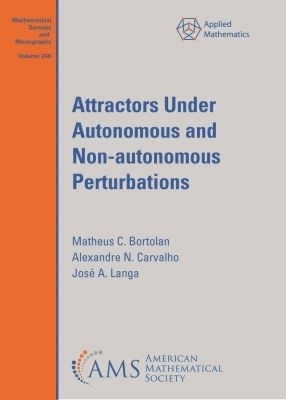
Attractors Under Autonomous and Non-autonomous Perturbations(English, Hardcover, Bortolan Matheus C.)
- Bortolan Matheus C.
Paperback & Hardcover deals ―
Amazon IndiaGOFlipkart ₹ 15926SnapdealGOSapnaOnlineGOJain Book AgencyGOBooks Wagon₹303Book ChorGOCrosswordGODC BooksGOe-book & Audiobook deals ―
Amazon India GOGoogle Play Books ₹140Audible GO* Price may vary from time to time.
* GO = We're not able to fetch the price (please check manually visiting the website).
Know about the book -
Attractors Under Autonomous and Non-autonomous Perturbations(English, Hardcover, Bortolan Matheus C.) is written by Bortolan Matheus C. and published by American Mathematical Society. It's available with International Standard Book Number or ISBN identification 1470453088 (ISBN 10) and 9781470453084 (ISBN 13).
This book provides a comprehensive study of how attractors behave under perturbations for both autonomous and non-autonomous problems. Furthermore, the forward asymptotics of non-autonomous dynamical systems is presented here for the first time in a unified manner. When modelling real world phenomena imprecisions are unavoidable. On the other hand, it is paramount that mathematical models reflect the modelled phenomenon, in spite of unimportant neglectable influences discounted by simplifications, small errors introduced by empirical laws or measurements, among others. The authors deal with this issue by investigating the permanence of dynamical structures and continuity properties of the attractor. This is done in both the autonomous (time independent) and non-autonomous (time dependent) framework in four distinct levels of approximation: the upper semicontinuity, lower semicontinuity, topological structural stability and geometrical structural stability. This book is aimed at graduate students and researchers interested in dissipative dynamical systems and stability theory, and requires only a basic background in metric spaces, functional analysis and, for the applications, techniques of ordinary and partial differential equations.
