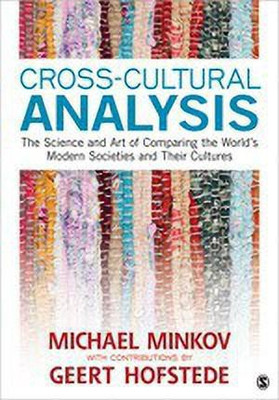
Cross-Cultural Analysis(English, Hardcover, Minkov Michael)
- Minkov Michael
Paperback & Hardcover deals ―
Amazon IndiaGOFlipkart ₹ 20394SnapdealGOSapnaOnlineGOJain Book AgencyGOBooks Wagon₹293Book ChorGOCrosswordGODC BooksGOe-book & Audiobook deals ―
Amazon India GOGoogle Play Books GOAudible GO* Price may vary from time to time.
* GO = We're not able to fetch the price (please check manually visiting the website).
Know about the book -
Cross-Cultural Analysis(English, Hardcover, Minkov Michael) is written by Minkov Michael and published by SAGE Publications Inc. It's available with International Standard Book Number or ISBN identification 1412992281 (ISBN 10) and 9781412992282 (ISBN 13).
Cross-Cultural Analysis is the sequel to Culture's Consequences, the classic work published by Geert Hofstede, one of the most influential management thinkers in today's times. Hofstede's original work introduced a new research paradigm in cross-cultural analysis: studying cultural differences through nation-level dimensions (complex variables defined by intercorrelated items). This paradigm has been subsequently used by hundreds of prominent scholars all over the world and has produced solid results. This new text takes the next step: It critically examines in one comprehensive volume the current, prevalent approaches to cross-cultural analysis at the level of nations that have been developed since Hofstede's work, offering students and researchers the theoretical and practical advantages and potential pitfalls of each method. The book is structured into four distinct parts. Parts I and II focus on the main theoretical and statistical issues in cross-cultural analysis using Hofstede's approach and the different research methods now associated with it. Part II consists of presentations of all well-known (and some lesser known) large-scale cross-cultural studies since Hofstede's work that have explained cross-cultural variation in terms of dimensional models. Part III summarizes the main conclusions to be drawn from the presentations in Part II and l explains how the proposed models have contributed to our practical understanding of cross-cultural diversity.
