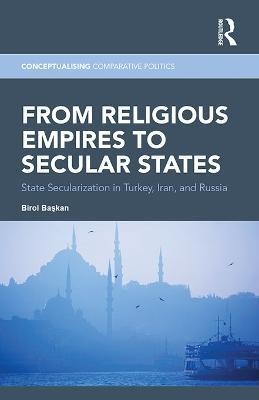
From Religious Empires to Secular States(English, Electronic book text, Baskan Birol)
- Baskan Birol
Paperback & Hardcover deals ―
Amazon IndiaGOFlipkart ₹ 3263SnapdealGOSapnaOnlineGOJain Book AgencyGOBooks Wagon₹425Book ChorGOCrosswordGODC BooksGOe-book & Audiobook deals ―
Amazon India GOGoogle Play Books ₹47.39Audible GO* Price may vary from time to time.
* GO = We're not able to fetch the price (please check manually visiting the website).
Know about the book -
From Religious Empires to Secular States(English, Electronic book text, Baskan Birol) is written by Baskan Birol and published by Taylor & Francis Ltd. It's available with International Standard Book Number or ISBN identification 1317802039 (ISBN 10) and 9781317802037 (ISBN 13).
In the 1920s and the 1930s, Turkey, Iran and Russia vehemently pursued state-secularizing reforms, but adopted different strategies in doing so. But why do states follow different secularizing strategies? The literature has already shattered the illusion that secularization of the state has been a unilinear, homogeneous and universal process, and has convincingly shown that secularization of the state has unfolded along different paths. Much, however, remains to be uncovered. This book provides an in-depth comparative historical analysis of state secularization in three major Eurasian countries: Turkey, Iran and Russia. To capture the aforementioned variation in state secularization across three countries that have been hitherto analyzed as separate studies, Birol Baskan adopts three modes of state secularization: accommodationism, separationism and eradicationism. Focusing thematically on the changing relations between the state and religious institutions, Baskan brings together a host of factors, historical, strategic and structural, to account for why Turkey adopted accommodationism, Iran separationism and Russia eradicationism. In doing so, he expertly demonstrates that each secularization strategy was a rational response to the strategic context the reformers found themselves in.
