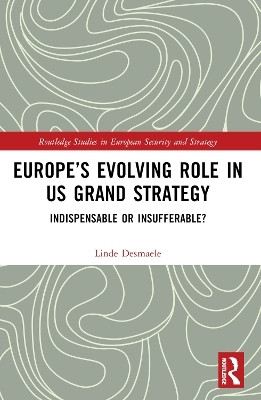
Europe's Evolving Role in US Grand Strategy(English, Paperback, Desmaele Linde)
- Desmaele Linde
Paperback & Hardcover deals ―
Amazon IndiaGOFlipkart ₹ 3876SnapdealGOSapnaOnlineGOJain Book AgencyGOBooks Wagon₹2,084Book ChorGOCrosswordGODC BooksGOe-book & Audiobook deals ―
Amazon India GOGoogle Play Books GOAudible GO* Price may vary from time to time.
* GO = We're not able to fetch the price (please check manually visiting the website).
Know about the book -
Europe's Evolving Role in US Grand Strategy(English, Paperback, Desmaele Linde) is written by Desmaele Linde and published by Taylor & Francis Ltd. It's available with International Standard Book Number or ISBN identification 1032424699 (ISBN 10) and 9781032424699 (ISBN 13).
This book looks at the evolution of the role of Europe in US grand strategy, and unpacks how US administrations have instrumentalized this relationship in pursuit of extra-European objectives. The work considers geopolitical pressures in conjunction with leaders' strategic ideas to provide an account of the evolution of the role of Europe in the context of US grand strategy. Observers generally agree on the vague notion that Europe has been de-prioritized in Washington's external affairs. Against this background, the book makes the case that such de-prioritization of Europe in the context of US grand strategy also entails a reconceptualization of the transatlantic relationship, namely as a region featuring long-standing relationships that can at times be leveraged in pursuit of non-European goals. The United States has a long history of seeking European support or acquiescence for its role as the leader of the international system, but whereas during the Cold War Washington enlisted its European allies in a grand strategic struggle against a European power, more recently, it has sought to enlist European allies in extra-European struggles of different types. Thinking about the role of Europe in US grand strategy now requires new theoretical and empirical tools that allow for the recognition of this very fact. Accordingly, this book proposes that strategic ideas on the viability of international cooperation held within the White House crucially shape what - if any -- type of support the United States seeks from Europe on the global stage. In doing so, the book adds important nuance to other accounts proclaiming either the proverbial death of the transatlantic relationship or the eternal and unchanging nature thereof. This book will be of much interest to students of European security, US foreign policy, and International Relations.
