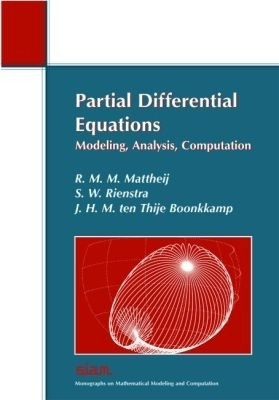
Partial Differential Equations(English, Paperback, Mattheij R.M.M.)
- Mattheij R.M.M.
Paperback & Hardcover deals ―
Amazon IndiaGOFlipkart ₹ 16295SnapdealGOSapnaOnlineGOJain Book AgencyGOBooks Wagon₹716Book ChorGOCrosswordGODC BooksGOe-book & Audiobook deals ―
Amazon India GOGoogle Play Books GOAudible GO* Price may vary from time to time.
* GO = We're not able to fetch the price (please check manually visiting the website).
Know about the book -
Partial Differential Equations(English, Paperback, Mattheij R.M.M.) is written by Mattheij R.M.M. and published by Society for Industrial & Applied Mathematics,U.S.. It's available with International Standard Book Number or ISBN identification 0898715946 (ISBN 10) and 9780898715941 (ISBN 13).
Partial differential equations (PDEs) are used to describe a large variety of physical phenomena, from fluid flow to electromagnetic fields, and are indispensable to such disparate fields as aircraft simulation and computer graphics. While most existing texts on PDEs deal with either analytical or numerical aspects of PDEs, this innovative and comprehensive textbook features a unique approach that integrates analysis and numerical solution methods and includes a third component - modeling - to address real-life problems. The authors believe that modeling can be learned only by doing; hence a separate chapter containing 16 user-friendly case studies of elliptic, parabolic, and hyperbolic equations is included and numerous exercises are included in all other chapters. Partial Differential Equations enables readers to deepen their understanding of a topic ubiquitous in mathematics and science and to tackle practical problems. The advent of fast computers and the development of numerical methods have enabled the modern engineer to use a large variety of packages to find numerical approximations to solutions of PDEs. Problems are usually standard and a thorough knowledge of a well-chosen subset of analytical and numerical tools and methodologies is necessary when dealing with real-life problems. When one is dealing with PDEs in practice, it becomes clear that both numerical and analytical treatments of the problem are needed.
