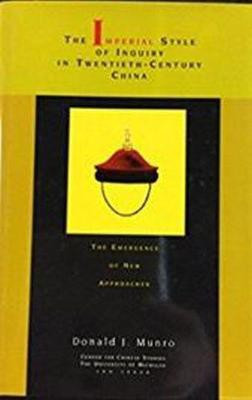
The Imperial Style of Inquiry in Twentieth-Century China(English, Hardcover, Munro Donald J.)
- Munro Donald J.
Paperback & Hardcover deals ―
Amazon IndiaGOFlipkart ₹ 2606SnapdealGOSapnaOnlineGOJain Book AgencyGOBooks Wagon₹550Book ChorGOCrosswordGODC BooksGOe-book & Audiobook deals ―
Amazon India GOGoogle Play Books GOAudible GO* Price may vary from time to time.
* GO = We're not able to fetch the price (please check manually visiting the website).
Know about the book -
The Imperial Style of Inquiry in Twentieth-Century China(English, Hardcover, Munro Donald J.) is written by Munro Donald J. and published by The University of Michigan Press. It's available with International Standard Book Number or ISBN identification 0892641207 (ISBN 10) and 9780892641208 (ISBN 13).
How have traditional Chinese ways of thinking affected problem solving in this century? The traditional, imperial style of inquiry is associated with the belief that the universe is a coherent, internally structured unity understandable through the similarly structured human mind. It involves a reliance on antecedent and authoritarian models, coupled with an introspective focus in investigations, at some cost to objective fact gathering. In contrast, emergent forms of inquiry are guided by the values of individual autonomy and new perspectives on objectivity. In the 1930s and 1940s, some liberal educators held the model of Western science in great esteem, and some scientists practicing objective inquiry helped to create an awareness in the urban areas of inquiry not directed by political values. Drawing on philosophical, social science, and popular culture materials, Donald Munro shows that the two strains coexisted in twentieth century China as mixed motives. Many important figures were motivated by a desire to act consistently with the social values associated with the premodern or received view of knowledge and inquiry. At the same time, these people often had other motives, such as utilitarian values, efficiency, and entrepreneurship. Munro argues that while many competing positions can coexist in the same person, the seeds of the positive, instrumental value of individual autonomy in Chinese inquiry are beginning to compete in both scholarly and popular culture with other, older approaches.
