American Mathematics 1890-1913(English, Paperback, Batterson Steve)
- Batterson Steve
Paperback & Hardcover deals ―
Amazon IndiaGOFlipkart ₹ 2913SnapdealGOSapnaOnlineGOJain Book AgencyGOBooks Wagon₹868Book ChorGOCrosswordGODC BooksGOe-book & Audiobook deals ―
Amazon India GOGoogle Play Books GOAudible GO* Price may vary from time to time.
* GO = We're not able to fetch the price (please check manually visiting the website).
Know about the book -
American Mathematics 1890-1913(English, Paperback, Batterson Steve) is written by Batterson Steve and published by Mathematical Association of America. It's available with International Standard Book Number or ISBN identification 0883855909 (ISBN 10) and 9780883855904 (ISBN 13).
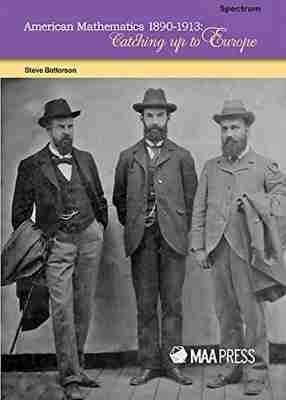
At the turn of the twentieth century, mathematical scholarship in the United States underwent a stunning transformation. In 1890, no American professor was producing mathematical research worthy of international attention. Graduate students were then advised to pursue their studies abroad. By the start of World War I, the standing of American mathematics had radically changed. George David Birkhoff, Leonard Dickson, and others were turning out cutting edge investigations that attracted notice in the intellectual centers of Europe. Harvard, Chicago, and Princeton maintained graduate programs comparable to those overseas. This book explores the people, timing, and factors behind this rapid advance. Through the mid-nineteenth century, most American colleges followed a classical curriculum that, in mathematics, rarely reached beyond calculus. With no doctoral programs of any sort in the United States until 1860, mathematical scholarship lagged far behind that in Europe. After the Civil War, visionary presidents at Harvard and Johns Hopkins broadened and deepened the opportunities for study. The breakthrough for mathematics began in 1890 with the hiring, in consecutive years, of William F. Osgood and Maxime Bocher at Harvard and E. H. Moore at Chicago. Each of these young men had studied in Germany where they acquired vital mathematical knowledge and taste. Over the next few years, Osgood, Bocher, and Moore established their own research programs and introduced new graduate courses. Working with other like-minded individuals through the nascent American Mathematical Society, the infrastructure of meetings and journals were created. In the early twentieth century, Princeton dramatically upgraded its faculty to give the United States the stability of a third mathematics center. The publication by Birkhoff, in 1913, of the solution to a famous conjecture served notice that American mathematics had earned consideration with the European powers of Germany, France, Italy, England, and Russia.
