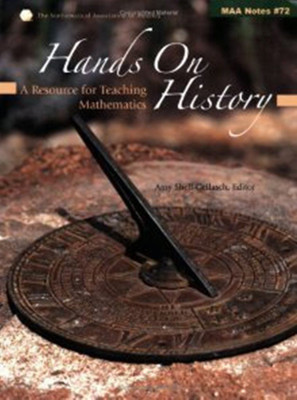
Hands on History: A Resource for Teaching Mathematics (Notes) (Mathematical Association of America Notes)(English, Hardcover, Amy Shell-gellasch)
- Amy Shell-gellasch
Paperback & Hardcover deals ―
Amazon IndiaGOFlipkart ₹ 3115SnapdealGOSapnaOnlineGOJain Book AgencyGOBooks WagonGOBook ChorGOCrosswordGODC BooksGOe-book & Audiobook deals ―
Amazon India GOGoogle Play Books GOAudible GO* Price may vary from time to time.
* GO = We're not able to fetch the price (please check manually visiting the website).
Know about the book -
Hands on History: A Resource for Teaching Mathematics (Notes) (Mathematical Association of America Notes)(English, Hardcover, Amy Shell-gellasch) is written by Amy Shell-gellasch and published by The Mathematical Association Of America. It's available with International Standard Book Number or ISBN identification 0883851822 (ISBN 10) and 9780883851821 (ISBN 13).
Research shows that students learn best when, as opposed to simply listening or reading, they actively participate in their learning. In particular, hands-on activities provide the greatest opportunities for gaining understanding and promoting retention. Apart from simple manipulatives, the mathematics classroom offers few options for hands-on activities. However, the history of mathematics offers many ways to incorporate hands-on learning into the mathematics classroom. Prior to computer modeling, many aspects of mathematics and its applications were explored and realized through mechanical models and devices. By bringing this material culture of mathematics into the classroom, students can experience historical applications and uses of mathematics in a setting rich in discovery and intellectual interest. Whether replicas of historical devices or models used to represent a topic from the history of mathematics, using models of a historical nature allows students to combine three important areas of their education: mathematics and mathematical reasoning; mechanical and spatial reasoning and manipulation; and evaluation of historical versus contemporary mathematical techniques. This volume is a compilation of articles from researchers and educators who use the history of mathematics to facilitate active learning in the classroom. The contributions range from simple devices such as the rectangular protractor that can be made in a geometry classroom, to elaborate models of descriptive geometry that can be used as a major project in a college mathematics course. Other chapters contain detailed descriptions on how to build and use historical models in the high school or collegiate mathematics classroom. Some of the items included in this volume are: sundials, planimeters, Napier s Bones, linkages, cycloid clock, a labyrinth and an apparatus that demonstrates the brachistocrone in the classroom.
