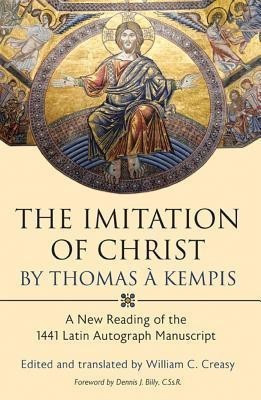
The Imitation of Christ(English, Hardcover, unknown)
- unknown
Paperback & Hardcover deals ―
Amazon IndiaGOFlipkart ₹ 2650SnapdealGOSapnaOnlineGOJain Book AgencyGOBooks Wagon₹185Book ChorGOCrosswordGODC BooksGOe-book & Audiobook deals ―
Amazon India GOGoogle Play Books ₹9.99Audible GO* Price may vary from time to time.
* GO = We're not able to fetch the price (please check manually visiting the website).
Know about the book -
The Imitation of Christ(English, Hardcover, unknown) is written by unknown and published by Mercer University Press. It's available with International Standard Book Number or ISBN identification 0881460974 (ISBN 10) and 9780881460971 (ISBN 13).
This translation maintains the fervor and power of the original text, but has been crafted for the modern reader The Imitation of Christ has appeared in more editions and in more languages than any other book except the Bible. Samuel Johnson once remarked to Bowell that it "must be a good book, as the world has opened its arms to receive it." Others have praised it as well, including Thomas Carlyle, George Eliot, Thomas De Quincey, and Matthew Arnold. Among the religious, St. Ignatius Loyola translated it, and Pope John Paul I was said to have been reading it the night that he died. It has been standard fare in religious training and personal devotion for centuries. Yet today, few people know the Imitation and those who do more often than not think it hopelessly out of date, a pre-Vatican II relic, full of contempt for the world and self-loathing. It is a curious state of affairs, and one that reveals more about a contemporary audience's response to the book than it does about the book itself. When a contemporary reader encounters a line such as "this is the highest wisdom: through contempt of the world to aspire to the kingdom of heaven," his response is a very different one from that of a fifteenth- or nineteenth- century reader. For an "uninformed response" (as Stanley Fish would say) to the contemptus mundi theme, the reader must draw deeply on a vast complex of literary, linguistic, historical, and theological knowledge. Creasy's translation of the Imitation strives to recreate a text that provides an analogous experience to that of the fifteenth-century reader. Relying heavily on reader-response theory, he incorporates an "informed reader's" response into the text itself. Where possible, the text echoes both the deep structure and the surface structure of the Latin-even to the point of replicating sentence structures and rhetorical devices while avoiding any distortion of the reader's experience.
