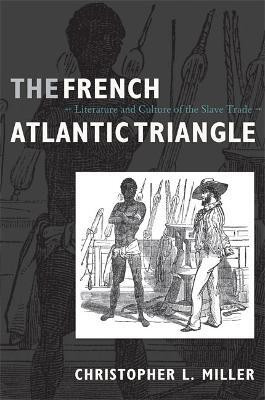
The French Atlantic Triangle(English, Paperback, Miller Christopher L.)
- Miller Christopher L.
Paperback & Hardcover deals ―
Amazon IndiaGOFlipkart ₹ 4037SnapdealGOSapnaOnlineGOJain Book AgencyGOBooks Wagon₹819Book ChorGOCrosswordGODC BooksGOe-book & Audiobook deals ―
Amazon India GOGoogle Play Books GOAudible GO* Price may vary from time to time.
* GO = We're not able to fetch the price (please check manually visiting the website).
Know about the book -
The French Atlantic Triangle(English, Paperback, Miller Christopher L.) is written by Miller Christopher L. and published by Duke University Press. It's available with International Standard Book Number or ISBN identification 0822341514 (ISBN 10) and 9780822341512 (ISBN 13).
The French slave trade forced more than one million Africans across the Atlantic to the islands of the Caribbean. It enabled France to establish Saint-Domingue, the single richest colony on earth, and it connected France, Africa, and the Caribbean permanently. Yet the impact of the slave trade on the cultures of France and its colonies has received surprisingly little attention. Until recently, France had not publicly acknowledged its history as a major slave-trading power. The distinguished scholar Christopher L. Miller proposes a thorough assessment of the French slave trade and its cultural ramifications, in a broad, circum-Atlantic inquiry. This magisterial work is the first comprehensive examination of the French Atlantic slave trade and its consequences as represented in the history, literature, and film of France and its former colonies in Africa and the Caribbean. Miller offers a historical introduction to the cultural and economic dynamics of the French slave trade, and he shows how Enlightenment thinkers such as Montesquieu and Voltaire mused about the enslavement of Africans, while Rousseau ignored it. He follows the twists and turns of attitude regarding the slave trade through the works of late-eighteenth- and early-nineteenth-century French writers, including Olympe de Gouges, Madame de StaEl, Madame de Duras, Prosper MErimEe, and EugEne Sue. For these authors, the slave trade was variously an object of sentiment, a moral conundrum, or an entertaining high-seas "adventure." Turning to twentieth-century literature and film, Miller describes how artists from Africa and the Caribbean-including the writers AimE CEsaire, Maryse CondE, and Edouard Glissant, and the filmmakers Ousmane Sembene, Guy Deslauriers, and Roger Gnoan M'Bala-have confronted the aftermath of France's slave trade, attempting to bridge the gaps between silence and disclosure, forgetfulness and memory.
