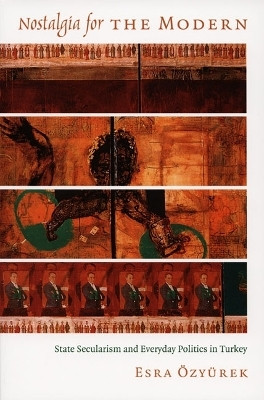
Nostalgia for the Modern(English, Paperback, OEzyuerek Esra)
- OEzyuerek Esra
Paperback & Hardcover deals ―
Amazon IndiaGOFlipkart ₹ 3811SnapdealGOSapnaOnlineGOJain Book AgencyGOBooks Wagon₹303Book ChorGOCrosswordGODC BooksGOe-book & Audiobook deals ―
Amazon India GOGoogle Play Books GOAudible GO* Price may vary from time to time.
* GO = We're not able to fetch the price (please check manually visiting the website).
Know about the book -
Nostalgia for the Modern(English, Paperback, OEzyuerek Esra) is written by OEzyuerek Esra and published by Duke University Press. It's available with International Standard Book Number or ISBN identification 0822338955 (ISBN 10) and 9780822338956 (ISBN 13).
As the twentieth century drew to a close, the unity and authority of the secularist Turkish state were challenged by the rise of political Islam and Kurdish separatism on the one hand and by the increasing demands of the European Union, the International Monetary Fund, and the World Bank on the other. While the Turkish government had long limited Islam-the religion of the overwhelming majority of its citizens-to the private sphere, it burst into the public arena in the late 1990s, becoming part of party politics. As religion became political, symbols of Kemalism-the official ideology of the Turkish Republic founded by Mustafa Kemal AtatUErk in 1923-spread throughout the private sphere. In Nostalgia for the Modern, Esra OEzyUErek analyzes the ways that Turkish citizens began to express an attachment to-and nostalgia for-the secularist, modernist, and nationalist foundations of the Turkish Republic. Drawing on her ethnographic research in Istanbul and Ankara during the late 1990s, OEzyUErek describes how ordinary Turkish citizens demonstrated their affinity for Kemalism in the ways they organized their domestic space, decorated their walls, told their life stories, and interpreted political developments. She examines the recent interest in the private lives of the founding generation of the Republic, reflects on several privately organized museum exhibits about the early Republic, and considers the proliferation in homes and businesses of pictures of AtatUErk, the most potent symbol of the secular Turkish state. She also explores the organization of the 1998 celebrations marking the Republic's seventy-fifth anniversary. OEzyUErek's insights into how state ideologies spread through private and personal realms of life have implications for all societies confronting the simultaneous rise of neoliberalism and politicized religion.
