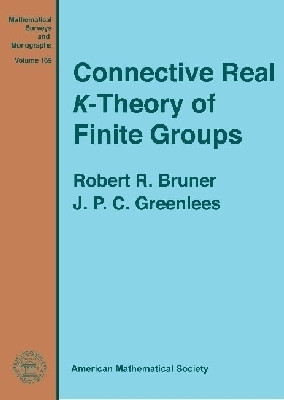
Connective Real K-Theory of Finite Groups(English, Hardcover, Bruner Robert R.)
- Bruner Robert R.
Paperback & Hardcover deals ―
Amazon IndiaGOFlipkart ₹ 2747SnapdealGOSapnaOnlineGOJain Book AgencyGOBooks Wagon₹3,891Book ChorGOCrosswordGODC BooksGOe-book & Audiobook deals ―
Amazon India GOGoogle Play Books ₹103Audible GO* Price may vary from time to time.
* GO = We're not able to fetch the price (please check manually visiting the website).
Know about the book -
Connective Real K-Theory of Finite Groups(English, Hardcover, Bruner Robert R.) is written by Bruner Robert R. and published by American Mathematical Society. It's available with International Standard Book Number or ISBN identification 0821851896 (ISBN 10) and 9780821851890 (ISBN 13).
This book is about equivariant real and complex topological $K$-theory for finite groups. Its main focus is on the study of real connective $K$-theory including $ko^*(BG)$ as a ring and $ko_*(BG)$ as a module over it. In the course of their study the authors define equivariant versions of connective $KO$-theory and connective $K$-theory with reality, in the sense of Atiyah, which give well-behaved, Noetherian, uncompleted versions of the theory. They prove local cohomology and completion theorems for these theories, giving a means of calculation as well as establishing their formal credentials. In passing from the complex to the real theories in the connective case, the authors describe the known failure of descent and explain how the $\eta$-Bockstein spectral sequence provides an effective substitute. This formal framework allows the authors to give a systematic calculation scheme to quantify the expectation that $ko^*(BG)$ should be a mixture of representation theory and group cohomology. It is characteristic that this starts with $ku^*(BG)$ and then uses the local cohomology theorem and the Bockstein spectral sequence to calculate $ku_*(BG)$, $ko^*(BG)$, and $ko_*(BG)$. To give the skeleton of the answer, the authors provide a theory of $ko$-characteristic classes for representations, with the Pontrjagin classes of quaternionic representations being the most important. Building on the general results, and their previous calculations, the authors spend the bulk of the book giving a large number of detailed calculations for specific groups (cyclic, quaternion, dihedral, $A_4$, and elementary abelian 2-groups). The calculations illustrate the richness of the theory and suggest many further lines of investigation. They have been applied in the verification of the Gromov-Lawson-Rosenberg conjecture for several new classes of finite groups.|This book is about equivariant real and complex topological $K$-theory for finite groups. Its main focus is on the study of real connective $K$-theory including $ko^*(BG)$ as a ring and $ko_*(BG)$ as a module over it. In the course of their study the authors define equivariant versions of connective $KO$-theory and connective $K$-theory with reality, in the sense of Atiyah, which give well-behaved, Noetherian, uncompleted versions of the theory. They prove local cohomology and completion theorems for these theories, giving a means of calculation as well as establishing their formal credentials. In passing from the complex to the real theories in the connective case, the authors describe the known failure of descent and explain how the $\eta$-Bockstein spectral sequence provides an effective substitute. This formal framework allows the authors to give a systematic calculation scheme to quantify the expectation that $ko^*(BG)$ should be a mixture of representation theory and group cohomology. It is characteristic that this starts with $ku^*(BG)$ and then uses the local cohomology theorem and the Bockstein spectral sequence to calculate $ku_*(BG)$, $ko^*(BG)$, and $ko_*(BG)$. To give the skeleton of the answer, the authors provide a theory of $ko$-characteristic classes for representations, with the Pontrjagin classes of quaternionic representations being the most important. Building on the general results, and their previous calculations, the authors spend the bulk of the book giving a large number of detailed calculations for specific groups (cyclic, quaternion, dihedral, $A_4$, and elementary abelian 2-groups). The calculations illustrate the richness of the theory and suggest many further lines of investigation. They have been applied in the verification of the Gromov-Lawson-Rosenberg conjecture for several new classes of finite groups.
