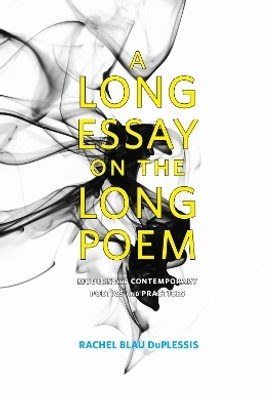
A Long Essay on the Long Poem(English, Paperback, DuPlessis Rachel Blau)
- DuPlessis Rachel Blau
Paperback & Hardcover deals ―
Amazon IndiaGOFlipkart ₹ 4373SnapdealGOSapnaOnlineGOJain Book AgencyGOBooks Wagon₹303Book ChorGOCrosswordGODC BooksGOe-book & Audiobook deals ―
Amazon India GOGoogle Play Books GOAudible GO* Price may vary from time to time.
* GO = We're not able to fetch the price (please check manually visiting the website).
Know about the book -
A Long Essay on the Long Poem(English, Paperback, DuPlessis Rachel Blau) is written by DuPlessis Rachel Blau and published by The University of Alabama Press. It's available with International Standard Book Number or ISBN identification 0817360689 (ISBN 10) and 9780817360689 (ISBN 13).
A masterful meditation on our most mercurial and abiding of poetic forms-the long poem For decades, Rachel Blau DuPlessis has shown readers how genres, forms, and the literal acts of writing and reception can be understood as sites of struggle. In her own words, "writing is a praxis in which the author disappears into a process, into a community, into discontinuities, and into a desire for discovery." It is cause for celebration, then, that we have another work of warm, incisive, exploratory writing from DuPlessis in A Long Essay on the Long Poem. Long poems, DuPlessis notes, are elusive, particularly in the slippery forms that have emerged in the postmodern mode. She cites both Nathaniel Mackey and Anne Waldman in thinking of the poem as a "box," both in the sense of a vessel that contains and as a machine that processes, an instrument on which language is played. This study's central attention is on the long poem as a sociocultural Book, distinctively envisioned by a range of authors. To reckon with these shifting and evolving forms, DuPlessis works in a polyvalent mode, a hybrid of critical analysis and speculative essay. She divides the long poem and the long poets into three genres: epics, quests, and a composite she terms "assemblages." The poets she surveys include T. S. Eliot, Ezra Pound, H.D., Louis Zukofsky, Gwendolyn Brooks, Charles Olson, Alice Notley, Nathaniel Mackey, Ron Silliman, Robert Duncan, Kamau Brathwaite, and, finally, MallarmE and Dante. Instead of a traditional lineage, she deliberately seeks intersecting patterns of connection between poems and projects, a nexus rather than a family tree. In doing so she navigates both some challenges of long poems and her own attempt to "essay" them. The result is a fascinating and generous work that defies categorization as anything other than essential.
