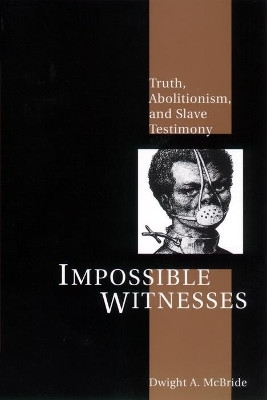
Impossible Witnesses(English, Paperback, McBride Dwight)
- McBride Dwight
Paperback & Hardcover deals ―
Amazon IndiaGOFlipkart ₹ 2332SnapdealGOSapnaOnlineGOJain Book AgencyGOBooks Wagon₹620Book ChorGOCrosswordGODC BooksGOe-book & Audiobook deals ―
Amazon India GOGoogle Play Books GOAudible GO* Price may vary from time to time.
* GO = We're not able to fetch the price (please check manually visiting the website).
Know about the book -
Impossible Witnesses(English, Paperback, McBride Dwight) is written by McBride Dwight and published by New York University Press. It's available with International Standard Book Number or ISBN identification 0814756050 (ISBN 10) and 9780814756058 (ISBN 13).
Even the most cursory review of black literary production during the nineteenth century indicates that its primary concerns were the issues of slavery, racial subjugation, abolitionist politics and liberation. How did the writers of these narratives "bear witness" to the experiences they describe? At a time when a hegemonic discourse on these subjects already existed, what did it mean to "tell the truth" about slavery? Impossible Witnesses explores these questions through a study of fiction, poetry, essays, and slave narratives from the abolitionist era. Linking the racialized discourses of slavery and Romanticism, it boldly calls for a reconfiguration of U.S. and British Romanticism that places slavery at its center. Impossible Witnesses addresses some of the major literary figures and representations of slavery in light of discourses on natural rights and law, offers an account of Foucauldian discourse analysis as it applies to the problem of "bearing witness," and analyzes specific narratives such as "Narrative of the Life of Frederick Douglass," and "The Interesting Narrative of the Life of Olaudah Equiano." A work of great depth and originality, Impossible Witnesses renders traditional interpretations of Romanticism impossible and places Dwight A. McBride at the forefront of studies in race and literature.
