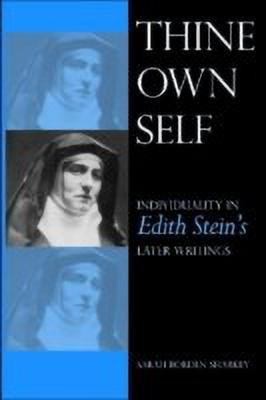
Thine Own Self(English, Paperback, Sharkey Sarah Borden)
- Sharkey Sarah Borden
Paperback & Hardcover deals ―
Amazon IndiaGOFlipkart ₹ 2714SnapdealGOSapnaOnlineGOJain Book AgencyGOBooks Wagon₹150Book ChorGOCrosswordGODC BooksGOe-book & Audiobook deals ―
Amazon India GOGoogle Play Books GOAudible GO* Price may vary from time to time.
* GO = We're not able to fetch the price (please check manually visiting the website).
Know about the book -
Thine Own Self(English, Paperback, Sharkey Sarah Borden) is written by Sharkey Sarah Borden and published by The Catholic University of America Press. It's available with International Standard Book Number or ISBN identification 0813216826 (ISBN 10) and 9780813216829 (ISBN 13).
Edith Stein was one of the important early phenomenologists. A German-Jewish philosopher, Discalced Carmelite nun, martyr, and saint who died in Auschwitz, Stein participated in the early 20th century revival of scholasticism and was much admired by John Paul II. ""Thine Own Self"" focuses on Stein's later writings and in particular her magnum opus, ""Finite and Eternal Being"". Although completed in 1936, Stein's book was not published at the time because of the new laws against non-Aryan publications, and the work sat completed but unread until after World War II. The recent availability of this book in English makes a substantive scholarly analysis of this major text particularly timely. ""Thine Own Self"" investigates Stein's account of human individuality and her mature philosophical positions on being and essence. Sarah Borden Sharkey shows how Stein's account of individual form adapts the Aristotelian-Thomistic tradition in order to account for evolution and more contemporary insights in personality and individual distinctiveness. Borden Sharkey explains how Stein's theory of individuality and individual forms is tied to her understanding of essence and being, and she compares Stein's distinctive metaphysical positions to those of Thomas Aquinas, John Duns Scotus, and Edmund Husserl. In addition to expositing Stein's metaphysical positions, Borden Sharkey argues that, although Stein's account of individual forms is both more contemporary and more adequate than John Duns Scotus' haecceitas, it is nonetheless problematic. The book concludes by defending a more Aristotelian-Thomistic understanding of form - albeit one that must be re articulated in light of contemporary and Steinian critiques.
