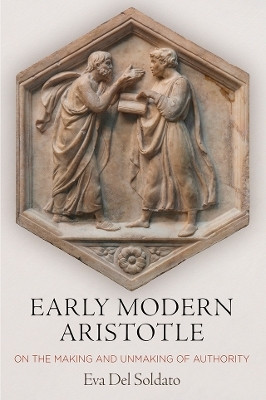
Early Modern Aristotle(English, Electronic book text, Soldato Eva Del)
- Soldato Eva Del
Paperback & Hardcover deals ―
Amazon IndiaGOFlipkart ₹ 2908SnapdealGOSapnaOnlineGOJain Book AgencyGOBooks Wagon₹1,217Book ChorGOCrosswordGODC BooksGOe-book & Audiobook deals ―
Amazon India GOGoogle Play Books ₹60Audible GO* Price may vary from time to time.
* GO = We're not able to fetch the price (please check manually visiting the website).
Know about the book -
Early Modern Aristotle(English, Electronic book text, Soldato Eva Del) is written by Soldato Eva Del and published by University of Pennsylvania Press. It's available with International Standard Book Number or ISBN identification 0812296826 (ISBN 10) and 9780812296822 (ISBN 13).
A reassessment of how the legacy of ancient philosophy functioned in early modern Europe In his Nicomachean Ethics, Aristotle affirms that despite his friendship with Plato, he was a better friend of the truth. With this statement, he rejected his teacher's authority, implying that the pursuit of philosophy does not entail any such obedience. Yet over the centuries Aristotle himself became the authority par excellence in the Western world, and even notorious anti-Aristotelians such as Galileo Galilei preferred to keep him as a friend rather than to contradict him openly. In Early Modern Aristotle, Eva Del Soldato contends that because the authority of Aristotle-like that of any other ancient, including Plato-was a construct, it could be tailored and customized to serve agendas that were often in direct contrast to one another, at times even in open conflict with the very tenets of Peripatetic philosophy. Arguing that recourse to the principle of authority was not merely an instrument for inculcating minds with an immutable body of knowledge, Del Soldato investigates the ways in which the authority of Aristotle was exploited in a variety of contexts. The stories the five chapters tell often develop along the same chronological lines, and reveal consistent diachronic and synchronic patterns. Each focuses on strategies of negotiation, integration and rejection of Aristotle, considering both macro-phenomena, such as the philosophical genre of the comparatio (that is, a comparison of Aristotle and Plato's lives and doctrines), and smaller-scale receptions, such as the circulation of legends, anecdotes, fictions, and rhetorical tropes ("if Aristotle were alive . . ."), all featuring Aristotle as their protagonist. Through the analysis of surprisingly neglected episodes in intellectual history, Early Modern Aristotle traces how the authority of the ancient philosopher-constantly manipulated and negotiated-shaped philosophical and scientific debate in Europe from the fifteenth century until the dawn of the Enlightenment.
