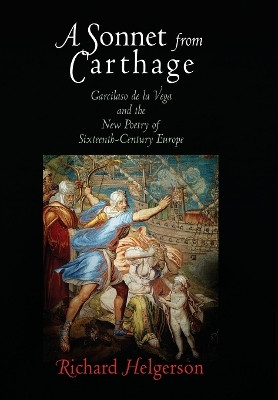
A Sonnet from Carthage(English, Hardcover, Helgerson Richard)
- Helgerson Richard
Paperback & Hardcover deals ―
Amazon IndiaGOFlipkart ₹ 4510SnapdealGOSapnaOnlineGOJain Book AgencyGOBooks Wagon₹1,221Book ChorGOCrosswordGODC BooksGOe-book & Audiobook deals ―
Amazon India GOGoogle Play Books GOAudible GO* Price may vary from time to time.
* GO = We're not able to fetch the price (please check manually visiting the website).
Know about the book -
A Sonnet from Carthage(English, Hardcover, Helgerson Richard) is written by Helgerson Richard and published by University of Pennsylvania Press. It's available with International Standard Book Number or ISBN identification 0812240049 (ISBN 10) and 9780812240047 (ISBN 13).
In 1492 the Spanish humanist Antonio de Nebrija proclaimed that "language has always been the companion of empire." Taking as his touchstone a wonderfully suggestive sonnet that Garcilaso de la Vega wrote in 1535 from the neighborhood of ruined Carthage in North Africa, Richard Helgerson examines how the companionship of language and empire played itself out more generally in the "new poetry" of sixteenth-century Europe. Along with his friend Juan BoscAn, Garcilaso was one of the great pioneers of that poetry, radically reforming Spanish verse in imitation of modern Italian and ancient Roman models. As the century progressed, similar projects were undertaken in France by Ronsard and du Bellay, in Portugal by CamOes, and in England by Sidney and Spenser. And wherever the new poetry emerged, it was prompted by a sense that imperial ambition-the quest to be in the present what Rome had been in the past-required a vernacular poetry comparable to the poetry of Rome. But, as Helgerson shows, the new poetry had other commitments than to empire. Though imperial ambition looms large in Garcilaso's sonnet and others, by the end of the poem Garcilaso identifies not with Rome but with the Carthaginian queen Dido, one of empire's legendary victims. And with this startling shift, which has its counterpart in poems from all over Europe, comes one of the most important departures the poem makes from its apparent imperial agenda. Addressing these rival concerns as they arise in a single sonnet, Richard Helgerson provides a masterful and multifaceted image of one of the most vital episodes in European literary history.
