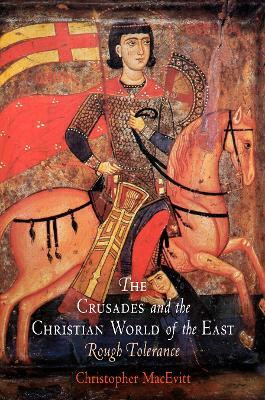
The Crusades and the Christian World of the East(English, Electronic book text, MacEvitt Christopher)
- MacEvitt Christopher
Paperback & Hardcover deals ―
Amazon IndiaGOFlipkart ₹ 2822SnapdealGOSapnaOnlineGOJain Book AgencyGOBooks Wagon₹212Book ChorGOCrosswordGODC BooksGOe-book & Audiobook deals ―
Amazon India GOGoogle Play Books ₹16.17Audible GO* Price may vary from time to time.
* GO = We're not able to fetch the price (please check manually visiting the website).
Know about the book -
The Crusades and the Christian World of the East(English, Electronic book text, MacEvitt Christopher) is written by MacEvitt Christopher and published by University of Pennsylvania Press. It's available with International Standard Book Number or ISBN identification 0812202694 (ISBN 10) and 9780812202694 (ISBN 13).
In the wake of Jerusalem's fall in 1099, the crusading armies of western Christians known as the Franks found themselves governing not only Muslims and Jews but also local Christians, whose culture and traditions were a world apart from their own. The crusader-occupied swaths of Syria and Palestine were home to many separate Christian communities: Greek and Syrian Orthodox, Armenians, and other sects with sharp doctrinal differences. How did these disparate groups live together under Frankish rule? In The Crusades and the Christian World of the East, Christopher MacEvitt marshals an impressive array of literary, legal, artistic, and archeological evidence to demonstrate how crusader ideology and religious difference gave rise to a mode of coexistence he calls "rough tolerance." The twelfth-century Frankish rulers of the Levant and their Christian subjects were separated by language, religious practices, and beliefs. Yet western Christians showed little interest in such differences. Franks intermarried with local Christians and shared shrines and churches, but they did not hesitate to use military force against Christian communities. Rough tolerance was unlike other medieval modes of dealing with religious difference, and MacEvitt illuminates the factors that led to this striking divergence. "It is commonplace to discuss the diversity of the Middle East in terms of Muslims, Jews, and Christians," MacEvitt writes, "yet even this simplifies its religious complexity." While most crusade history has focused on Christian-Muslim encounters, MacEvitt offers an often surprising account by examining the intersection of the Middle Eastern and Frankish Christian worlds during the century of the First Crusade.
