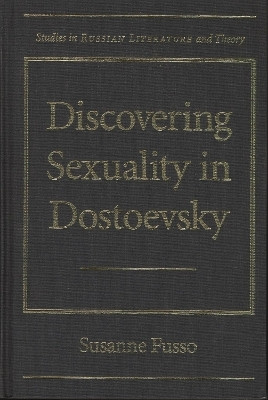
Discovering Sexuality in Dostoevsky(English, Hardcover, Fusso Susanne)
- Fusso Susanne
Paperback & Hardcover deals ―
Amazon IndiaGOFlipkart ₹ 2910SnapdealGOSapnaOnlineGOJain Book AgencyGOBooks Wagon₹1,114Book ChorGOCrosswordGODC BooksGOe-book & Audiobook deals ―
Amazon India GOGoogle Play Books GOAudible GO* Price may vary from time to time.
* GO = We're not able to fetch the price (please check manually visiting the website).
Know about the book -
Discovering Sexuality in Dostoevsky(English, Hardcover, Fusso Susanne) is written by Fusso Susanne and published by Northwestern University Press. It's available with International Standard Book Number or ISBN identification 0810121077 (ISBN 10) and 9780810121072 (ISBN 13).
Most discussions of sexuality in the work of Dostoevsky have been framed in Freudian terms. But Dostoevsky himself wrote about sexuality from a decidedly pre-Freudian perspective. By looking at the views of human sexual development that were available in Dostoevsky's time and that he, an avid reader and observer of his own social context, absorbed and reacted to, Susanne Fusso gives us a new way of understanding a critical element in the writing of one of Russia's literary masters. Beyond discovering Dostoevsky's own views and representations of sexuality as a reflection of his culture and his time, Fusso also explores his artistic treatment of how children and adolescents discover sexuality as part of their growth. Some of the topics Fusso considers are Dostoevsky's search for an appropriate artistic language for sexuality, a young narrator's experimentation with homoerotic desire and unconventional narrative in "A Raw Youth"; and Dostoevsky's approach to a young man's sexual development in "A Raw Youth" and "The Brothers Karamazov".She also explores his complex treatment of a child's secret sexuality in his account of the Kroneberg child abuse case in "A Writer's Diary"; and his conception of the ideal family, a type of family that appears in his works mainly by negative example. Focusing mainly on sexual practices considered "deviant" in Dostoevsky's time - both because these are the practices that his young characters confront and because they offer the most intriguing interpretive problems - Fusso decodes the author's texts and their social contexts. In doing so, she highlights one thread in the intricate thematic weave of Dostoevsky's novels and newly illuminates his artistic process.
