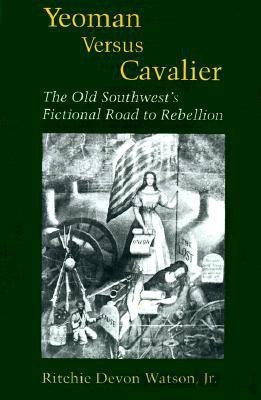
Yeoman Versus Cavalier(English, Paperback, Jr Ritchie Devon Watson)
- Jr Ritchie Devon Watson
Paperback & Hardcover deals ―
Amazon IndiaGOFlipkart ₹ 3143SnapdealGOSapnaOnlineGOJain Book AgencyGOBooks Wagon₹378Book ChorGOCrosswordGODC BooksGOe-book & Audiobook deals ―
Amazon India GOGoogle Play Books GOAudible GO* Price may vary from time to time.
* GO = We're not able to fetch the price (please check manually visiting the website).
Know about the book -
Yeoman Versus Cavalier(English, Paperback, Jr Ritchie Devon Watson) is written by Jr Ritchie Devon Watson and published by Louisiana State University Press. It's available with International Standard Book Number or ISBN identification 0807125253 (ISBN 10) and 9780807125250 (ISBN 13).
In Yeoman Versus Cavalier: The Old Southwest's Fictional Road to Rebellion, Ritchie Devon Watson, Jr., examines the emergence of the planter-aristocrat over the yeoman as the dominant cultural icon in the newly settled states of the Old Southwest - Kentucky, Tennessee, Alabama, Mississippi, Louisiana, and Arkansas - during the first half of the nineteenth century. He related this region's shift in cultural ideals, as reflected in its literature, both to the coming of the Civil War and the failure of the postbellum South to reintegrate itself fully into the nation.In the early 1800s Thomas Jefferson's stalwart yeoman farmer was the mythic figure that gave the most dynamic expression to and most compelling justification for expansion to the west. This potent symbol of rural democracy was enthusiastically embraced by settlers in both midwestern and southern territories. By 1830, however, residents of the new southern states had initiated a profound imaginative movement away from the frontier myths that had linked them with midwesterners. Faced with increasingly hostile attacks on slavery and the plantation system, southerners from Virginia to Louisiana united in defense of the plantation South. Watson shows how writers of the Old Southwest reflected this cultural shift in their tendency to idealize the planter and to subvert, subordinate, or ignore the yeoman. Joining cultural and intellectual forces with the more established plantation societies of the Eastern Seaboard, these writers turned toward the Cavalier - the noble, cultured planter of aristocratic blood and manners who, like a father, presided with wisdom and love over a large plantation - as the primary representative of the southern way of life.Watson builds his argument by analysing many different kinds of writing. Choosing texts that shed light on the newly evolving culture of the Old Southwest, Watson discusses the novelists William Garrott Brown, James Lane Allen, Joseph Holt Ingraham, Caroline Lee Hentz, and Augusta Jane Evans, historian Charles Gayarre, humorists Augustus Baldwin Longstreet and Thomas Bangs Thorpe, New South propagandist Henry Grady, novelist and story writer George Washington Cable, and poets Joseph Brennan and Sidney Lanier.The Cavalier ideal, Watson explains, unified the states of the Confederacy and served as a kind if icon to be carried into battle. After the war the figure was resurrected by southern writers and made an integral part of the region's Lost Cause myth, which northerners helped perpetuate. The Cavalier figure has continued to lead a vigorous life into the present century, as attested by novels such as Margaret Mitchell's Gone With the Wind, Stark Young's So Red the Rose, and even William Faulkner's Absalom, Absalom!Yeoman Versus Cavalier is a solid and entertainingly written analysis of how the Cavalier, as the South's unifying mythical figure, helped shape southern history and the creation of the legend of the Old South following the Civil War. It contributes greatly to our understanding of the antebellum South and demonstrates how studying a work of literature can lead to a fuller comprehension of the culture that produced it.
