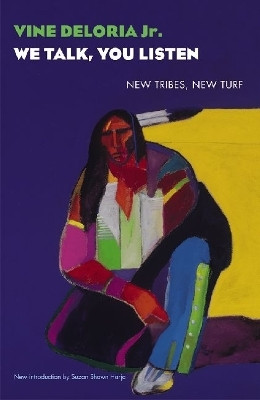
We Talk, You Listen(English, Paperback, Deloria Jr. Vine)
- Deloria Jr. Vine
Paperback & Hardcover deals ―
Amazon IndiaGOFlipkart ₹ 1889SnapdealGOSapnaOnlineGOJain Book AgencyGOBooks Wagon₹295Book ChorGOCrosswordGODC BooksGOe-book & Audiobook deals ―
Amazon India GOGoogle Play Books GOAudible GO* Price may vary from time to time.
* GO = We're not able to fetch the price (please check manually visiting the website).
Know about the book -
We Talk, You Listen(English, Paperback, Deloria Jr. Vine) is written by Deloria Jr. Vine and published by University of Nebraska Press. It's available with International Standard Book Number or ISBN identification 0803259859 (ISBN 10) and 9780803259850 (ISBN 13).
We Talk, You Listen is strong, boldly unconventional medicine from Vine Deloria Jr. (1933-2005), one of the most important voices of twentieth-century Native American affairs. Here the witty and insightful Indian spokesman turns his penetrating vision toward the disintegrating core of American society. Written at a time when the traditions of the formerly omnipotent Anglo-Saxon male were crumbling under the pressures of a changing world, Deloria's book interprets racial conflict, inflation, the ecological crisis, and power groups as symptoms rather than causes of the American malaise: "The glittering generalities and mythologies of American society no longer satisfy the need and desire to belong," a theory as applicable today as it was in 1970. American Indian tribalism, according to Deloria, was positioned to act as America's salvation. Deloria proposes a uniquely Indian solution to the legacy of genocide, imperialism, capitalism, feudalism, and self-defeating liberalism: group identity and real community development, a kind of neo-tribalism. He also offers a fascinating cultural critique of the nascent "tribes" of the 1970s, indicting Chicanos, blacks, hippies, feminists, and others as misguided because they lacked comprehensive strategies and were led by stereotypes rather than an understanding of their uniqueness.
