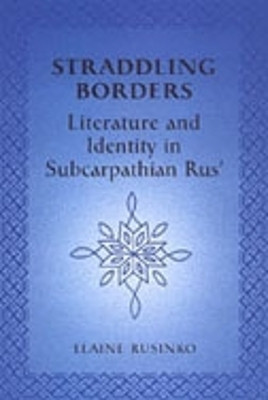
Straddling Borders(English, Hardcover, Rusinko Elaine)
- Rusinko Elaine
Paperback & Hardcover deals ―
Amazon IndiaGOFlipkart ₹ 9780SnapdealGOSapnaOnlineGOJain Book AgencyGOBooks Wagon₹10,006Book ChorGOCrosswordGODC BooksGOe-book & Audiobook deals ―
Amazon India GOGoogle Play Books GOAudible GO* Price may vary from time to time.
* GO = We're not able to fetch the price (please check manually visiting the website).
Know about the book -
Straddling Borders(English, Hardcover, Rusinko Elaine) is written by Rusinko Elaine and published by University of Toronto Press. It's available with International Standard Book Number or ISBN identification 0802037119 (ISBN 10) and 9780802037114 (ISBN 13).
The Subcarpathian Rusyns are an east Slavic people who live along the southern slopes of the Carpathian mountains where the borders of Ukraine, Slovakia, and Poland meet. Through centuries of oppression under the Austro-Hungarian and Soviet empires, they have struggled to preserve their culture and identity. Rusyn literature, reflecting various national influences and written in several linguistic variants, has historically been a response to social conditions, an affirmation of identity, and a strategy to ensure national survival. In this first English-language study of Rusyn literature, Elaine Rusinko looks at the literary history of Subcarpathia from the perspective of cultural studies and postcolonial theory, presenting Rusyn literature as a process of continual negotiation among states, religions, and languages, resulting in a characteristic hybridity that has made it difficult to classify Rusyn literature in traditional literary scholarship. Rusinko traces Rusyn literature from its emergence in the sixteenth century, through the national awakening of the mid-nineteenth century and its struggle for survival under Hungarian oppression, to its renaissance in inter-war Czechoslovakia. She argues that Rusyn literature provides an acute illustration of the constructedness of national identity, and has prefigured international postmodern culture with its emphasis on border-crossings, intersecting influences, and liminal spaces. With extracts from Rusyn texts never before available in English, Rusinko's study creates an entirely new perspective on Rusyn literature that rescues it from the cliches of Soviet dominated critical theory and makes an important contribution to Slavic studies in particular and post-colonial critical studies in general.
