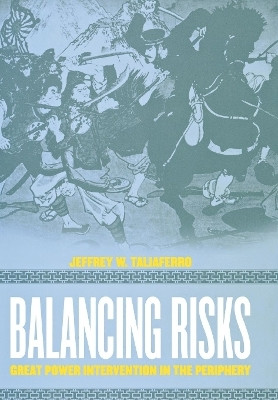
Balancing Risks(English, Hardcover, Taliaferro Jeffrey W.)
- Taliaferro Jeffrey W.
Paperback & Hardcover deals ―
Amazon IndiaGOFlipkart ₹ 7050SnapdealGOSapnaOnlineGOJain Book AgencyGOBooks Wagon₹976Book ChorGOCrosswordGODC BooksGOe-book & Audiobook deals ―
Amazon India GOGoogle Play Books GOAudible GO* Price may vary from time to time.
* GO = We're not able to fetch the price (please check manually visiting the website).
Know about the book -
Balancing Risks(English, Hardcover, Taliaferro Jeffrey W.) is written by Taliaferro Jeffrey W. and published by Cornell University Press. It's available with International Standard Book Number or ISBN identification 0801442214 (ISBN 10) and 9780801442216 (ISBN 13).
Great powers often initiate risky military and diplomatic inventions in far-off, peripheral regions that pose no direct threat to them, risking direct confrontation with rivals in strategically inconsequential places. Why do powerful countries behave in a way that leads to entrapment in prolonged, expensive, and self-defeating conflicts? Jeffrey W. Taliaferro suggests that such interventions are driven by the refusal of senior officials to accept losses in their state's relative power, international status, or prestige. Instead of cutting their losses, leaders often continue to invest blood and money in failed excursions into the periphery. Their policies may seem to be driven by rational concerns about power and security, but Taliaferro deems them to be at odds with the master explanation of political realism. Taliaferro constructs a "balance-of-risk" theory of foreign policy that draws on defensive realism (in international relations) and prospect theory (in psychology). He illustrates the power of this new theory in several case narratives: Germany's initiation and escalation of the 1905 and 1911 Moroccan crises, the United States' involvement in the Korean War in 1950-52, and Japan's entanglement in the second Sino-Japanese war in 1937-40 and its decisions for war with the U.S. in 1940-41.
