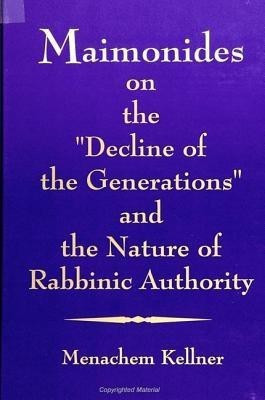
Maimonides on the "Decline of the Generations" and the Nature of Rabbinic Authority(English, Paperback, Kellner Menachem)
- Kellner Menachem
Paperback & Hardcover deals ―
Amazon IndiaGOFlipkart ₹ 3283SnapdealGOSapnaOnlineGOJain Book AgencyGOBooks WagonGOBook ChorGOCrosswordGODC BooksGOe-book & Audiobook deals ―
Amazon India GOGoogle Play Books GOAudible GO* Price may vary from time to time.
* GO = We're not able to fetch the price (please check manually visiting the website).
Know about the book -
Maimonides on the "Decline of the Generations" and the Nature of Rabbinic Authority(English, Paperback, Kellner Menachem) is written by Kellner Menachem and published by State University of New York Press. It's available with International Standard Book Number or ISBN identification 0791429229 (ISBN 10) and 9780791429228 (ISBN 13).
Shows to what extent and in what fashion Jews are bound to accept the opinions and the pronouncements of religious authorities. Moses Maimonides, medieval Judaism's leading legist and philosopher, and a figure of central importance for contemporary Jewish self-understanding, held a view of Judaism which maintained the authority of the Talmudic rabbis in matters of Jewish law while allowing for free and open inquiry in matters of science and philosophy. Maimonides affirmed, not the superiority of the "moderns" (the scholars of his and subsequent generations) over the "ancients" (the Tannaim and Amoraim, the Rabbis of the Mishnah and Talmud) but the inherent equality of the two. The equality presented here is not equality of halakhic authority, but equality of ability, of essential human characteristics. In order to substantiate these claims, Kellner explores the related idea that Maimonides does not adopt the notion of "the decline of the generations," according to which each succeeding generation, or each succeeding epoch, is in some significant and religiously relevant sense inferior to preceding generations or epochs.
