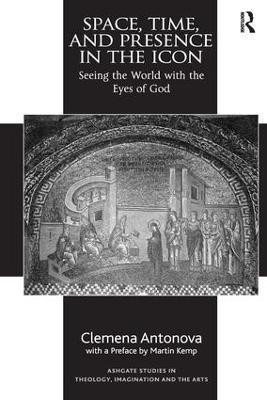
Space, Time, and Presence in the Icon(English, Hardcover, Antonova Clemena)
- Antonova Clemena
Paperback & Hardcover deals ―
Amazon IndiaGOFlipkart ₹ 2618SnapdealGOSapnaOnlineGOJain Book AgencyGOBooks Wagon₹319Book ChorGOCrosswordGODC BooksGOe-book & Audiobook deals ―
Amazon India GOGoogle Play Books GOAudible GO* Price may vary from time to time.
* GO = We're not able to fetch the price (please check manually visiting the website).
Know about the book -
Space, Time, and Presence in the Icon(English, Hardcover, Antonova Clemena) is written by Antonova Clemena and published by Taylor & Francis Ltd. It's available with International Standard Book Number or ISBN identification 0754667987 (ISBN 10) and 9780754667988 (ISBN 13).
This book contributes to the re-emerging field of 'theology through the arts' by proposing a way of approaching one of the most challenging theological concepts - divine timelessness - through the principle of construction of space in the icon. One of the main objectives of this book is to discuss critically the implications of 'reverse perspective', which is especially characteristic of Byzantine and Byzantining art. Drawing on the work of Pavel Florensky, one of the foremost Russian religious philosophers at the beginning of the 20th century, Antonova shows that Florensky's concept of 'supplementary planes' can be used productively within a new approach to the question. Antonova works up new criteria for the understanding of how space and time can be handled in a way that does not reverse standard linear perspective (as conventionally claimed) but acts in its own way to create eternalised images which are not involved with perspective at all. Arguing that the structure of the icon is determined by a conception of God who exits in past, present, and future, simultaneously, Antonova develops an iconography of images done in the Byzantine style both in the East and in the West which is truer to their own cultural context than is generally provided for by western interpretations. This book draws upon philosophy, theology and liturgy to see how relatively abstract notions of a deity beyond time and space enter images made by painters.
