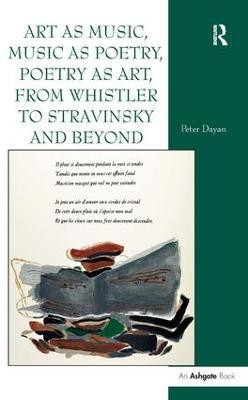
Art as Music, Music as Poetry, Poetry as Art, from Whistler to Stravinsky and Beyond(English, Hardcover, Dayan Peter)
- Dayan Peter
Paperback & Hardcover deals ―
Amazon IndiaGOFlipkart ₹ 2876SnapdealGOSapnaOnlineGOJain Book AgencyGOBooks WagonGOBook ChorGOCrosswordGODC BooksGOe-book & Audiobook deals ―
Amazon India GOGoogle Play Books GOAudible GO* Price may vary from time to time.
* GO = We're not able to fetch the price (please check manually visiting the website).
Know about the book -
Art as Music, Music as Poetry, Poetry as Art, from Whistler to Stravinsky and Beyond(English, Hardcover, Dayan Peter) is written by Dayan Peter and published by Taylor & Francis Ltd. It's available with International Standard Book Number or ISBN identification 075466791X (ISBN 10) and 9780754667919 (ISBN 13).
In 1877, Ruskin accused Whistler of 'flinging a pot of paint in the public's face'. Was he right? After all, Whistler always denied that the true function of art was to represent anything. If a painting does not represent, what is it, other than mere paint, flung in the public's face? Whistler's answer was simple: painting is music - or it is poetry. Georges Braque, half a century later, echoed Whistler's answer. So did Braque's friends Apollinaire and Ponge. They presented their poetry as music too - and as painting. But meanwhile, composers such as Satie and Stravinsky were presenting their own art - music - as if it transposed the values of painting or of poetry. The fundamental principle of this intermedial aesthetic, which bound together an extraordinary fraternity of artists in all media in Paris, from 1885 to 1945, was this: we must always think about the value of a work of art, not within the logic of its own medium, but as if it transposed the value of art in another medium. Peter Dayan traces the history of this principle: how it created our very notion of 'great art', why it declined as a vision from the 1960s and how, in the 21st century, it is fighting back.
